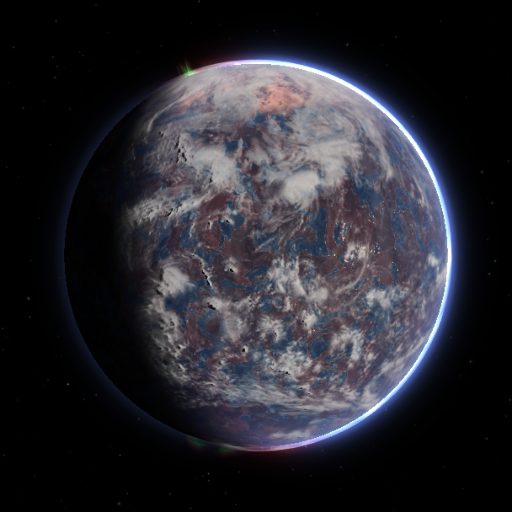
Kepler-186 f
Also written Kepler-186f, Kepler 186f, Kepler 186 f
- Mass (est.)
- 1.71 × Earth
- Radius
- 1.17 × Earth
- Gravity (est.)
- 1.25 g
- Surface (est.)
- 274 K
- Year
- 130 days
- From Earth
- 581 ly
- Mass (est.)
- 1.71 × Earth
- Radius
- 1.17 × Earth
- Gravity (est.)
- 1.25 g
- Surface (est.)
- 274 K
- Year
- 130 days
- From Earth
- 581 ly
Kepler-186 system
- Type
- K-type (Orange)
- Spectral type
- M1
- Temperature
- 3,755 K
- Radius
- 0.523 ☉
- Mass
- 0.544 ☉
- Planets
- 5
- Luminosity
- 0.0550 ☉
Published by the NASA Exoplanet Archive. This world’s temperature and habitability score are computed from this star’s measured luminosity, not from a stand-in for its class.
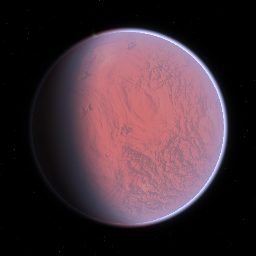
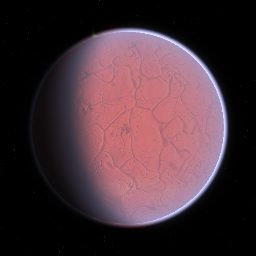
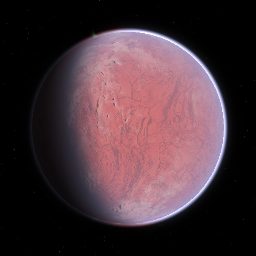
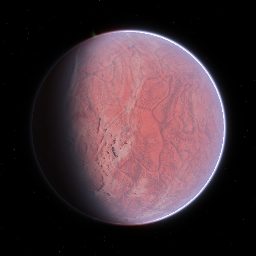
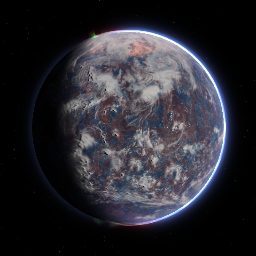 Kepler-186 f0.43 AUYou are here≈1.7 M⊕
Star and planets drawn to scale: the star is 49 times as wide as Kepler-186 f, so only its edge is in view. Orbits spaced as in the star system view.
Estimated: this planet's mass hasn't been measured, so it's estimated from its size
In April 2014 Kepler-186 f became the first Earth-size planet found in the habitable zone of another star, the range of distances where liquid water could pool on a surface. NASA's Kepler space telescope caught it passing in front of its star. A team led by Elisa Quintana of the SETI Institute at NASA's Ames Research Center announced it. Earlier habitable-zone planets were all at least 40 percent larger than Earth.
Surface. Rocky surface with continents, oceans, and active plate tectonics. Diverse biomes if life present.
✓ Conditions could support life. This planet’s modelled conditions could support biological processes: stable temperatures, liquid water and the chemistry life as we know it needs. That makes life possible, not present.
Nitrogen-oxygen atmosphere with trace CO₂, water vapor, and argon
Nitrogen-oxygen atmosphere - breathable and protectivePhysical Properties
Elemental Composition
How TerraForge built this world
Kepler-186 f, from the NASA Exoplanet Archive (found 2014). Measured: 1.71 Earth masses, 0.432 AU, a 3755 K K-type star. Composition inferred from a estimated bulk density of 1.07x Earth's, which is rock and iron, with an assumed 24-hour day, though it may be tidally locked: its star would stop its spin within 2.4 billion years, close to the star's age of 4 billion years, so the day is assumed. Note: TerraForge comes out at 274 K against the archive's 177 K, because the two make different assumptions about how much light the planet reflects and how its atmosphere holds and spreads heat.