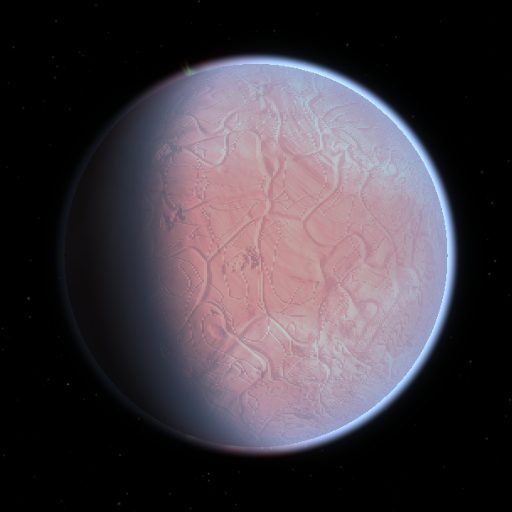
Kepler-90 i
Also written Kepler-90i, Kepler 90i, Kepler 90 i
- Mass (est.)
- 2.30 × Earth
- Radius
- 1.32 × Earth
- Gravity (est.)
- 1.32 g
- Surface (est.)
- 967 K
- Year
- 14.4 days
- From Earth
- 2,766 ly
- Mass (est.)
- 2.30 × Earth
- Radius
- 1.32 × Earth
- Gravity (est.)
- 1.32 g
- Surface (est.)
- 967 K
- Year
- 14.4 days
- From Earth
- 2,766 ly
KOI-351 system
- Type
- F-type (White)
- Temperature
- 6,015 K
- Radius
- 1.29 ☉
- Mass
- 1.12 ☉
- Planets
- 8
- Luminosity
- 1.86 ☉
Published by the NASA Exoplanet Archive. This world’s temperature and habitability score are computed from this star’s measured luminosity, not from a stand-in for its class.
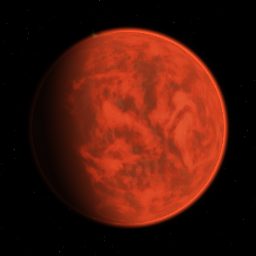
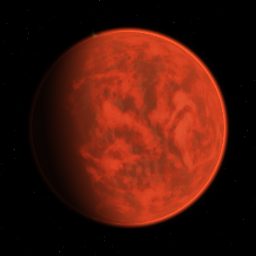
 Kepler-90 i0.12 AUYou are here≈2.3 M⊕
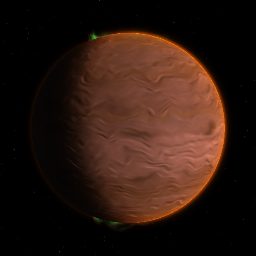
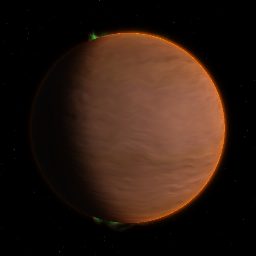
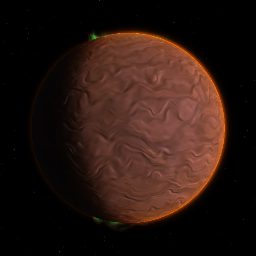
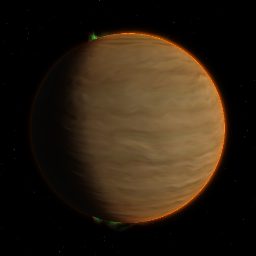
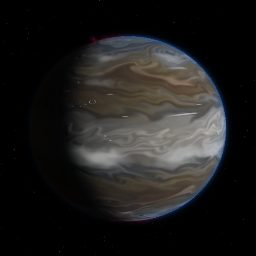
Star and planets drawn to scale: the star is 107 times as wide as Kepler-90 i, so only its edge is in view. Orbits spaced as in the star system view.
Estimated: this planet's mass hasn't been measured, so it's estimated from its size
Kepler-90 i is the planet that made Kepler-90 the first known star to tie our solar system's count of eight planets, and it was found with artificial intelligence. Kepler-90 is a Sun-like star about 2,800 light-years away. Its eighth planet orbits every 14.4 days, third from the star, between Kepler-90 c and d. According to NASA, it is a rocky planet with an average surface temperature above 800 degrees Fahrenheit.
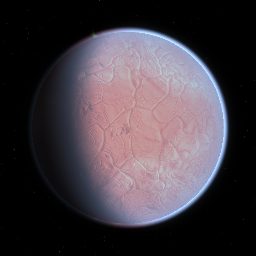
Surface. Rocky surface with impact craters, possible volcanic features
Thin CO₂ and nitrogen atmosphere
Nitrogen atmosphere provides protection but not breathable (its active star has stripped much of its air over 0.5 billion years)Physical Properties
Time Dilation
Clocks run 5.1 seconds per year slower than deep space — about 7 minutes over a lifetimeElemental Composition
How TerraForge built this world
Kepler-90 i, from the NASA Exoplanet Archive (found 2017). Measured: 2.3 Earth masses, 0.12 AU, a 6015 K F-type star. Composition inferred from a estimated bulk density of 1.00x Earth's at this size, suggesting roughly 10% water/ice by mass, with a day locked to its 14.4-day year, as it is predicted to be tidally locked: at this distance its star would have stopped its spin within a million years. Note: TerraForge comes out at 967 K against the archive's 709 K, because the two make different assumptions about how much light the planet reflects and how its atmosphere holds and spreads heat.