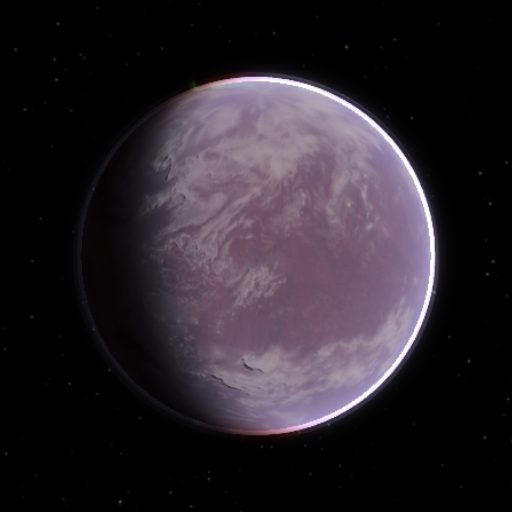
GJ 1061 b is the innermost of three rocky-sized planets around GJ 1061, a small red dwarf about 12 light-years away and one of the 20 nearest stars to the Sun. It orbits every 3.21 days. It was found together with its siblings GJ 1061 c and d by the Red Dots team, led by Stefan Dreizler, who watched the star nightly for three months in 2018 with the HARPS spectrograph in Chile.
They used the radial velocity method, which detects the slight back-and-forth motion a planet's gravity gives its star. The three orbits, at about 3.2, 6.7 and 13 days, are close to a ratio of 1 to 2 to 4: each planet takes about twice as long as the one inside it. That near-resonance turned out to matter. Planets in such a pattern tug on each other in measurable ways, and in 2025 the team, adding new measurements from the ESPRESSO spectrograph, used those tugs to work out the planets' true masses rather than only lower limits. They found GJ 1061 b to have about 1.07 Earth masses, assuming the three orbits lie in the same plane.
That is very close to Earth's mass, and the 2025 study concluded that all three planets are potentially rocky. GJ 1061 b is the hottest of the three, nearest the upper end of their estimated equilibrium temperatures of about 240 to 360 kelvin, and it orbits closer in than the habitable zone, the range of distances where liquid water could last on a surface. GJ 1061 is similar to Proxima Centauri in size and type, but shows lower levels of activity, which is better for planets keeping their atmospheres. None of the planets passes in front of the star, so their sizes are not known.