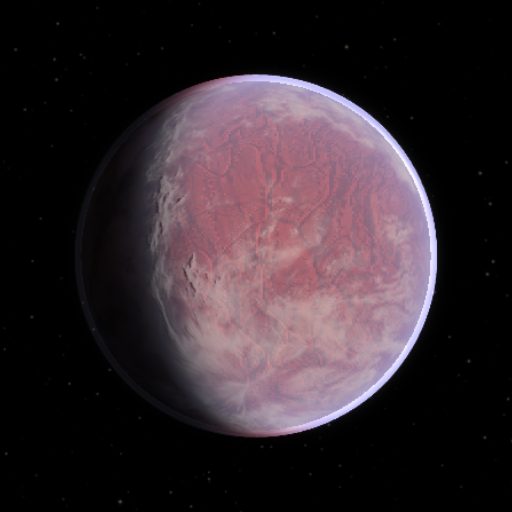
Gl 725 A b is a probable super-Earth, a planet heavier than Earth but lighter than Neptune, orbiting a red dwarf about 11.5 light-years away. Its star, Gl 725 A, has a companion red dwarf, Gl 725 B, so this is a planet in a double-star system, circling just one of the two stars. A team led by P. Cortés-Zuleta reported it in 2024.
The signal was found by the radial velocity method, which detects the slight back-and-forth motion a planet's gravity gives its star. What makes this detection stronger is that two different instruments picked it up independently: SOPHIE, which measures visible light, and SPIRou, which measures infrared light. Activity on a star's surface can mimic a planet, but it usually looks different at different wavelengths, so a signal that matches in both is harder to explain away. The team modelled the star's activity separately for each instrument.
The planet orbits every 11.22 days, on a nearly circular path, and has a minimum mass of about 2.8 Earth masses. Because it was found from its star's motion, only that lower limit is known. The team searched 27 sectors of data from NASA's TESS satellite and found no sign of it passing in front of the star, so its size has not been measured. Comparing it with planets of known mass and size, they predict a radius between 1.2 and 2.0 times Earth's.
The authors describe it as a potential super-Earth and a candidate, the cautious wording used while a planet awaits further confirmation. If it holds up, it is one of the closest planets to the Sun, and it adds to a small group of low-mass planets on short orbits around nearby red dwarfs in multiple-star systems.