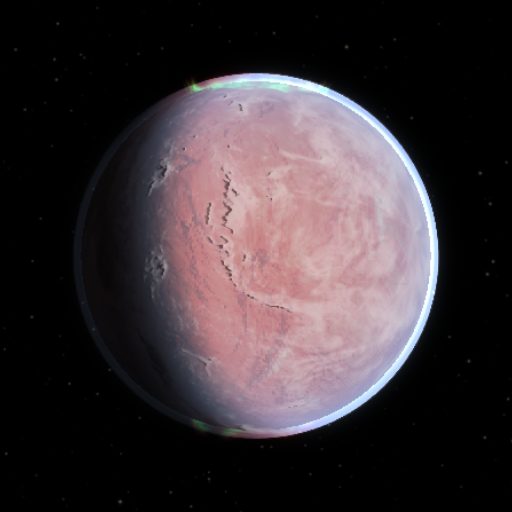
Tau Ceti h orbits Tau Ceti, the closest single Sun-like star to us, about 12 light-years away, once every 49 days. Its minimum mass is about 1.8 Earth masses. It sits between the inner planet Tau Ceti g and the two outer planets, e and f.
It was one of two entirely new signals announced in 2017 by a team led by Fabo Feng at the University of Hertfordshire, alongside Tau Ceti g; the other two planets had been suspected before. All four were found by the radial velocity method, which detects the slight back-and-forth motion a planet's gravity gives its star. These signals are very small, as little as 30 centimetres per second. To find them, the team modelled a source of noise in the data that changes with the colour of the starlight.
At 49 days it is too close to its star for liquid water, which needs a cooler orbit around a star as bright as Tau Ceti; the archive estimates its equilibrium temperature at about 470 kelvin. Unlike Tau Ceti g, its signal has not been independently confirmed in data from a second telescope, and the discovery paper describes all four as planet candidates. None has been seen crossing in front of the star, so their sizes are unknown. Later modelling of the system by Jeremy Dietrich's team in 2020 suggested more planets may be waiting to be found, including one in the habitable zone.