Create your free account

Enter your email and we'll send a 6-digit code — no password needed.
We only keep your email and the username you choose. We never share or sell your email, and we don't send marketing — we use it only to email you a sign-in code. Read our privacy policy.
Entering orbit…
Habitability
23/ 100
Extremely Harsh
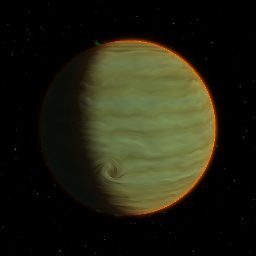
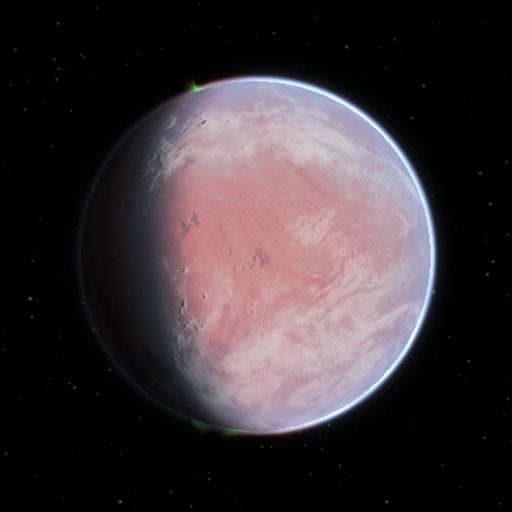
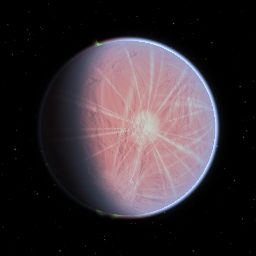
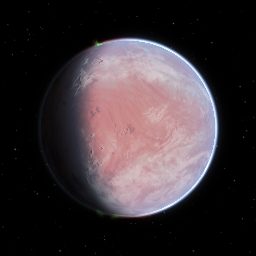
tau Cet h rendered in TerraForge from its measured mass, orbit and star

tau Cet h

Also written tau Ceth

Rocky Terrestrial12 light years awayFound 2017
Mass
1.83 × Earth
Radius
1.19 × Earth
Gravity
1.29 g
Surface (est.)
480 K
Year
49.4 days
From Earth
11.7 ly
Mass
1.83 × Earth
Radius
1.19 × Earth
Gravity
1.29 g
Surface (est.)
480 K
Year
49.4 days
From Earth
11.7 ly

tau Cet system

Type
G-type (Yellow (Sun-like))
Spectral type
G8.5V
Temperature
5,310 K
Radius
0.83 ☉
Mass
0.783 ☉
Planets
3
Luminosity
0.495 ☉

Published by the NASA Exoplanet Archive. This world’s temperature and habitability score are computed from this star’s measured luminosity, not from a stand-in for its class.
Habitable zone

Star and planets drawn to scale: the star is 76 times as wide as tau Cet h, so only its edge is in view. Orbits spaced as in the star system view.

Estimated: this planet doesn't transit its star, so its size is inferred, not measured

Tau Ceti h orbits Tau Ceti, the closest single Sun-like star to us, about 12 light-years away, once every 49 days. Its minimum mass is about 1.8 Earth masses. It sits between the inner planet Tau Ceti g and the two outer planets, e and f.

Surface. Rocky surface with impact craters, possible volcanic features

Rocky Terrestrial
Life unlikely — too hot for liquid waterMagnetic FieldModerate Activity
tau Cet h is dominated by silicate (25.0%) and iron (12.5%) content, forming a rocky terrestrial body.
Rocky terrestrial planets are primarily composed of silicate rocks and metals. They're the most common type of small planet in the universe.
Classification Criteria:
✓ Silicon: 25.0% + Iron: 12.5% + Magnesium: 3.8%✓ Mass: 1.8x Earth (terrestrial range)

Reading tau Cet h’s atmosphere

Dominant elements: O, Si, Fe, N, C, HThis is what a telescope would measure while tau Cet h crosses in front of its star: starlight passes through the atmosphere and spreads into a rainbow band. Each dark line marks a wavelength the atmosphere absorbed.Every element absorbs its own signature wavelengths — hydrogen always darkens the same two spots, calcium another pair, and so on. Astronomers match the lines in a real spectrum against a library of these signatures to say what an atmosphere is made of, light-years away, without ever visiting. A deeper line generally means more of that element is present.tau Cet h sits about 12 light-years away, found by the radial velocity method. Most catalogued distances trace back to parallax: as Earth orbits the Sun, a nearby star appears to shift very slightly against the distant background stars, and the size of that shift gives its distance directly.
Habitability ScoreExtremely Harsh
23
Contributing Factors
temperature10
Extremely hot - hostile to known life forms
atmosphere70

Thin CO₂ and nitrogen atmosphere

Nitrogen atmosphere provides protection but not breathable
water30
Limited water content - likely as steam
magnetic Field100
Magnetic field provides radiation protection
geology90
Active geology recycles nutrients and drives carbon cycle
Organic Chemistry80
Core organic elements (CHNO) present
rotation100
Optimal rotation period - balanced day/night cycle, moderate weather, and good heat distribution

Physical Properties

Mass
1.83x Earth (1.09e+25 kg)
Radius
1.22x Earth (7,793 km)
This planet: 1.22× Earth radiusEarth: 1× (baseline)
Surface Gravity
1.22x Earth (12.0 m/s²)
Surface Temperature
480 K (207 °C / 404 °F)
Rotation Period
24.0 hours/day
This planet: 24 h/dayEarth: 24 h/day

Elemental Composition

How TerraForge built this world

tau Cet h, from the NASA Exoplanet Archive (found 2017). Measured: 1.83 Earth masses, 0.243 AU, a 5310 K G-type star. Composition inferred from an estimated bulk density of 1.09x Earth's, modeled rather than measured since this isn't a transiting planet — the radius is the archive's estimate, so it can't settle how much water there is; read as rock and iron, with an assumed 24-hour day — rotation cannot be measured for exoplanets.

A dark ringed planet hanging over the horizon of a rocky moon, its rings lit by a distant sun

New: Stand on Your Moons 🌒

A planet's surface view isn't the only ground any more. Press the surface button on a planet with moons and it asks where to stand: the planet itself, or any moon still in orbit, each tagged with what it became — ocean, ice, carbon, volcanic. Every moon gets its own ground and sky from its own physics: airless rock under a black sky, ice cracked by geysers over a hidden sea, sulfur plains shaking with eruptions, or orange haze you can't see the sun through. And hanging over the horizon, there's the planet you built.

Create your free account

Enter your email and we'll send a 6-digit code — no password needed.
We only keep your email and the username you choose. We never share or sell your email, and we don't send marketing — we use it only to email you a sign-in code. Read our privacy policy.

Send feedback

We're still building out the best experience we can — and we'd love your input. Tell us about features you enjoy, ideas you'd like to see, or pain points where something feels off, and we'll know where to look next.

Type
Idea
Bug
Pain point
Other