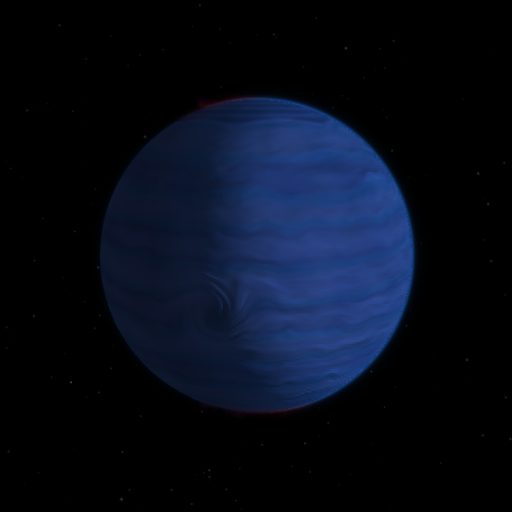
For about seven years, NASA's Transiting Exoplanet Survey Satellite (TESS) watched a giant planet called TOI-2535 b cross in front of its star, and then watched those crossings stop. A transit is the small dip in starlight seen when a planet passes across the face of its star from our point of view. Between 2019 and early 2026 the planet's transits grew shorter and shallower, and by 2026 they no longer appeared at all. The team that reported it, led by Samuel Yee at UCLA, describes it as the first confirmed planet orbiting a single star whose transits have been directly observed to disappear.

TOI-2535 b is a hot Jupiter, a gas giant that orbits very close to its star. It goes around once every 8.2 days at about 0.1 AU, a tenth of the distance between Earth and the Sun. It has about 0.47 times the mass of Jupiter, measured from the star's wobble, and a radius a little smaller than Jupiter's. Its star is a little cooler than the Sun and lies about 340 parsecs, or roughly 1,100 light-years, away.
The disappearing act points to a second planet that has not been seen directly. Its gravity slowly tilts the orbit of TOI-2535 b, so the path the planet traces across the star drifted toward the star's edge and finally off it. The transit times also wandered by up to six hours from a regular schedule. The researchers combined those timing and duration changes with radial-velocity measurements from the NEID spectrograph, which track tiny shifts in the star's light as orbiting planets tug it toward and away from us. They concluded that the hidden companion is likely at least as massive as Saturn, that its orbit is tilted against TOI-2535 b's by at least about 5 degrees, and that the two are probably locked in a mean-motion resonance, where their orbital periods form a simple ratio.
Much of this is still to be confirmed. The companion's mass and orbit come from modelling the hot Jupiter's behaviour rather than from seeing the companion itself. UCLA's announcement says TOI-2535 b should begin transiting again sometime in 30 to 50 years, and that the hidden neighbour may come into view sooner. The system may also say something about how hot Jupiters reach such tight orbits. Two giant planets this close together fit better with a slow inward spiral than with being flung inward. The researchers present this cautiously, as a formation route that may not happen very often.