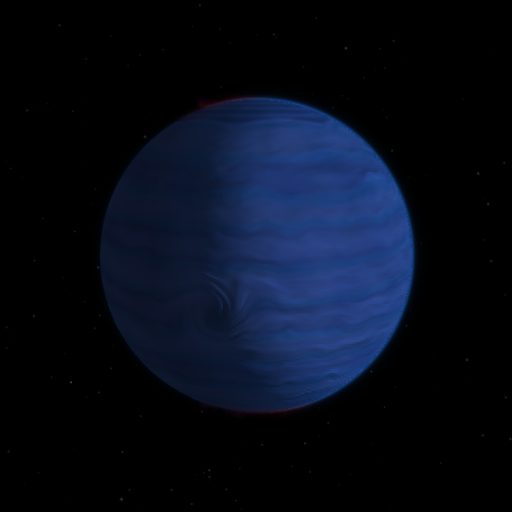
TOI-2535 b
Also written TOI-2535b, TOI 2535b, TOI 2535 b
- Mass
- 150.00 × Earth
- Radius
- 9.46 × Earth
- Gravity
- 1.68 g
- Surface (est.)
- 754 K
- Year
- 8.2 days
- From Earth
- 1,122 ly
- Mass
- 150.00 × Earth
- Radius
- 9.46 × Earth
- Gravity
- 1.68 g
- Surface (est.)
- 754 K
- Year
- 8.2 days
- From Earth
- 1,122 ly
TOI-2535 system
- Type
- G-type (Yellow (Sun-like))
- Spectral type
- G8V
- Temperature
- 5,256 K
- Radius
- 0.877 ☉
- Mass
- 0.864 ☉
- Planets
- 1
- Luminosity
- 0.529 ☉
Published by the Extrasolar Planets Encyclopaedia. This world’s temperature and habitability score are computed from its star’s published radius and temperature.
 TOI-2535 b0.099 AUYou are here150 M⊕
Star and planets drawn to scale: the star is 10 times as wide as TOI-2535 b, so only its edge is in view. Orbits spaced as in the star system view.
For about seven years, NASA's Transiting Exoplanet Survey Satellite (TESS) watched a giant planet called TOI-2535 b cross in front of its star, and then watched those crossings stop. A transit is the small dip in starlight seen when a planet passes across the face of its star from our point of view. Between 2019 and early 2026 the planet's transits grew shorter and shallower, and by 2026 they no longer appeared at all. The team that reported it, led by Samuel Yee at UCLA, describes it as the first confirmed planet orbiting a single star whose transits have been directly observed to disappear.
Surface. No solid surface - thick gaseous envelope with possible rocky core deep within
Hydrogen and helium dominated with trace methane and ammonia
Hydrogen-rich atmosphere typical of gas giantsPhysical Properties
Elemental Composition
How TerraForge built this world
TOI-2535 b, from the Extrasolar Planets Encyclopaedia (found 2026). Measured: 150 Earth masses, 0.0993 AU, a 5256 K G-type star. Composition inferred from a mass of 150 Earths, which is giant territory whatever its 0.18x density suggests, with a day locked to its 8.2-day year, as anything orbiting this close would be.