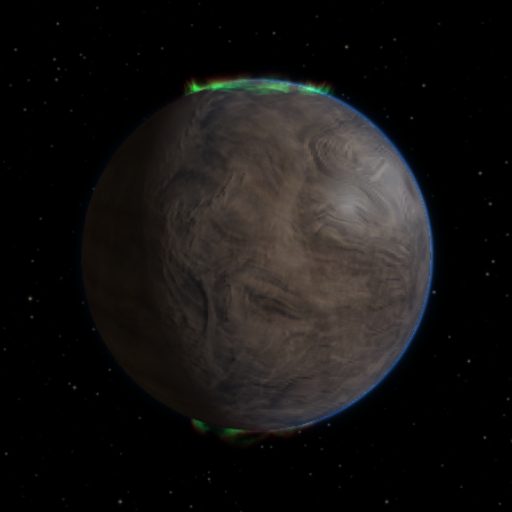
TOI-5699 b is as wide as Jupiter but carries only about a quarter of its mass, closer to Saturn's, which makes it a puffy, low-density giant. It orbits its star every 22 days at about 0.16 astronomical units (one astronomical unit is the Earth–Sun distance). NASA's TESS satellite caught it passing in front of its star, an event called a transit, and a team led by E. Knudstrup confirmed it in 2026, alongside the Jupiter-like TOI-5120 b, by measuring the star's slight wobble with the Tull coudé spectrograph at McDonald Observatory, which alone took 86 measurements between 2023 and 2026, and FIES on the Nordic Optical Telescope. The transit gives the planet's size and the wobble gives its mass.

It is a warm Jupiter: a gas giant on an orbit of roughly 8 to 200 days, farther from its star than the hot Jupiters. Warm Jupiters interest astronomers because their orbits are thought to keep a record of how they moved inward after forming, since their stars' tides are too weak to erase it. Its low mass and large size mean its atmosphere should extend far above the planet, and of the planets in its discovery paper it is the best target for transmission spectroscopy, which reads an atmosphere's ingredients from starlight filtering through it during a transit.
Its orbit is the open question. The team measures an eccentricity of about 0.30, a noticeably stretched orbit where zero would be a perfect circle, but cautions that a circular orbit cannot be ruled out and that more data are needed to show the value is not partly an artefact. If it is real, they say it is hard to explain if the planet formed where it is or drifted in smoothly through its birth disk, and that an unseen outer companion periodically stretching its orbit might explain it. Unlike the two other systems in the paper, no companion has been detected around it so far, though the data still leave room for one. The host star is a little more massive than the Sun, slightly evolved and about 305 parsecs away.