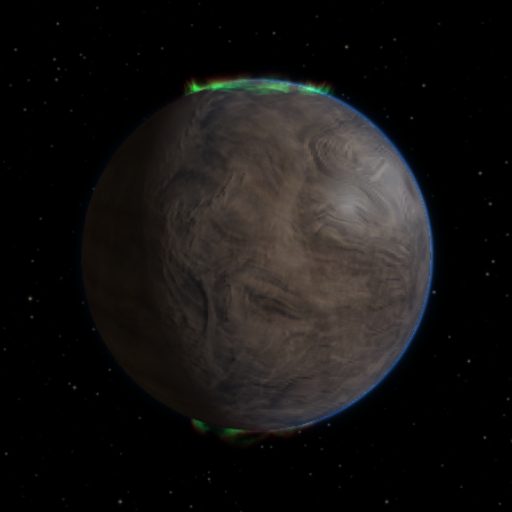
TOI-5699 b
Also written TOI-5699b, TOI 5699b, TOI 5699 b
TOI-5699 b is as wide as Jupiter but carries only about a quarter of its mass, closer to Saturn's, which makes it a puffy, low-density giant. It orbits its star every 22 days at about 0.16 astronomical units (one astronomical unit is the Earth–Sun distance). NASA's TESS satellite caught it passing in front of its star, an event called a transit, and a team led by E. Knudstrup confirmed it in 2026, alongside the Jupiter-like TOI-5120 b, by measuring the star's slight wobble with the Tull coudé spectrograph at McDonald Observatory, which alone took 86 measurements between 2023 and 2026, and FIES on the Nordic Optical Telescope. The transit gives the planet's size and the wobble gives its mass.
TOI-5699
- Type
- G-type (Yellow (Sun-like))
- Temperature
- 5,905 K
- Radius
- 1.64 ☉
- Mass
- 1.13 ☉
- Known planets
- 1 (this one)
- Luminosity
- 3.30 ☉
Published by the NASA Exoplanet Archive. This world’s temperature and habitability score are computed from this star’s measured luminosity, not from a stand-in for its class.
Gas Giant

Physical Properties
Orbital Environment
Atmosphere
Elemental Composition
Surface Characteristics
No solid surface - thick gaseous envelope with possible rocky core deep withinHow TerraForge built this world
TOI-5699 b, from the NASA Exoplanet Archive (found 2026). Measured: 79.5 Earth masses, 0.16 AU, a 5905 K G-type star. Composition inferred from a mass of 79.5 Earths, which is giant territory whatever its 0.06x density suggests, with an assumed 24-hour day — rotation cannot be measured for exoplanets.