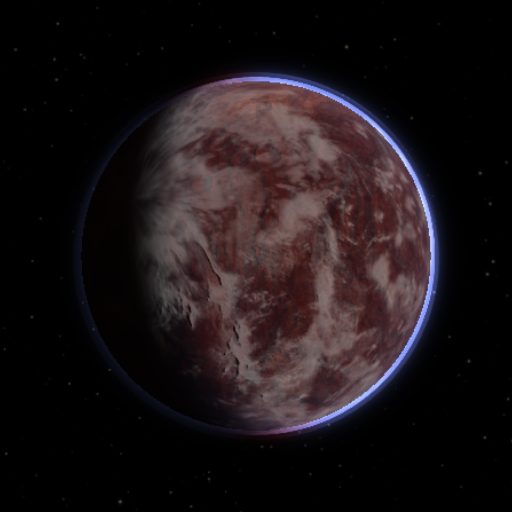
TRAPPIST-1 d sits roughly where you would hope to find a second Earth, and the James Webb Space Telescope has now looked closely enough to say it is not one. The planet is a little smaller than Earth, about 0.79 times its width and 0.39 times its mass. It orbits only about 2 percent of Earth's distance from the Sun, so its year lasts about four days. Its red dwarf star is so dim that this tight orbit gives d about the same amount of energy that Earth receives from the Sun.
It was one of the first three planets reported around TRAPPIST-1, in May 2016, by a team led by Michaël Gillon of the University of Liège. They used the Belgian TRAPPIST telescope at ESO's La Silla Observatory in Chile and the transit method, which spots the small dip in starlight when a planet crosses in front of its star. At first d's orbit was poorly known: the team could only say its period lay somewhere between 4.5 and 73 days. Follow-up with NASA's Spitzer Space Telescope and other telescopes, published in 2017, found seven planets and settled d's period at about 4.04 days.
In 2025 a team led by Caroline Piaulet-Ghorayeb reported what Webb saw during two transits of d. They used transmission spectroscopy. As a planet crosses its star, a little starlight filters through any atmosphere it has, and each gas absorbs its own set of colours. Webb's NIRSpec instrument found no sign of water, methane or carbon dioxide. The team ruled out, at more than 95 percent confidence, atmospheres like those of Saturn's moon Titan, early Mars and the early Earth, as well as cloud-free versions of Venus and modern Earth.
That does not prove d is airless. ESA lists three possibilities still open: a very thin atmosphere, somewhat like Mars's; thick, high clouds like Venus's that hide the gases beneath; or bare rock. The star often flares, releasing high-energy radiation that can strip the air from small planets. That is one reason astronomers see the outer planets e, f, g and h as better prospects. If d does turn out to be bare, the team's models suggest that planets b, c and d formed with less than about four Earth oceans' worth of water.
TerraForge's model, working only from d's mass, orbit and star, classifies it as a rocky terrestrial world at 289 K, close to the archive's equilibrium temperature of 286 K, which is the temperature a planet would reach from starlight alone, with no greenhouse warming. The rocky label agrees with the measurements, but the model cannot see Webb's missing atmosphere, so its middling habitability score reflects d's size and orbit rather than what has been observed.