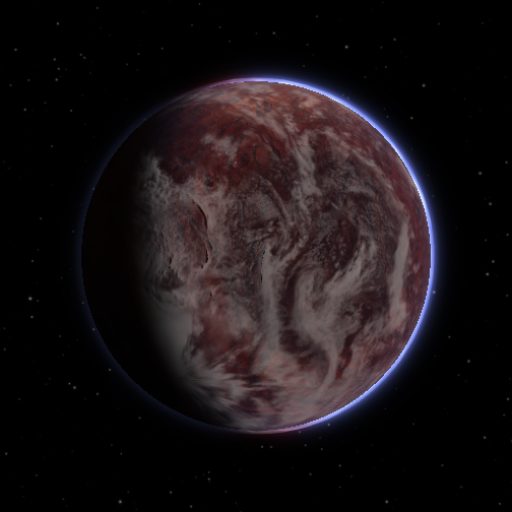
TRAPPIST-1 d
Also written TRAPPIST-1d, TRAPPIST 1d, TRAPPIST 1 d
- Mass
- 0.39 × Earth
- Radius
- 0.79 × Earth
- Gravity
- 0.62 g
- Surface (est.)
- 289 K
- Year
- 4.0 days
- From Earth
- 40.4 ly
- Mass
- 0.39 × Earth
- Radius
- 0.79 × Earth
- Gravity
- 0.62 g
- Surface (est.)
- 289 K
- Year
- 4.0 days
- From Earth
- 40.4 ly
TRAPPIST-1 system
- Type
- M-type (Red Dwarf)
- Spectral type
- M8.0 V
- Temperature
- 2,566 K
- Radius
- 0.119 ☉
- Mass
- 0.0898 ☉
- Planets
- 7
- Luminosity
- 5.53e-4 ☉
Published by the NASA Exoplanet Archive. This world’s temperature and habitability score are computed from this star’s measured luminosity, not from a stand-in for its class.
 TRAPPIST-1 d0.022 AUYou are here0.4 M⊕
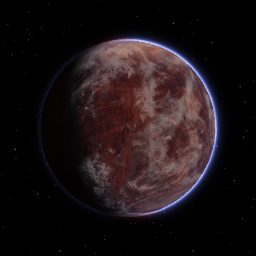
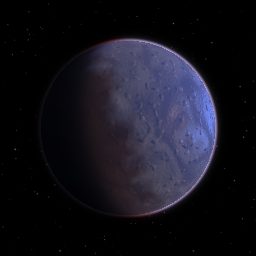
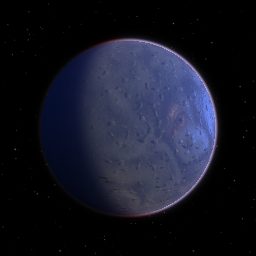
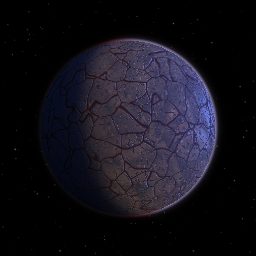
Star and planets drawn to scale: the star is 16 times as wide as TRAPPIST-1 d, so only its edge is in view. Orbits spaced as in the star system view.
TRAPPIST-1 d sits roughly where you would hope to find a second Earth, and the James Webb Space Telescope has now looked closely enough to say it is not one. The planet is a little smaller than Earth, about 0.79 times its width and 0.39 times its mass. It orbits only about 2 percent of Earth's distance from the Sun, so its year lasts about four days. Its red dwarf star is so dim that this tight orbit gives d about the same amount of energy that Earth receives from the Sun.
Surface. Rocky surface with impact craters, possible volcanic features
✓ Conditions could support life. This planet’s modelled conditions could support biological processes: stable temperatures, liquid water and the chemistry life as we know it needs. That makes life possible, not present.
Thin CO₂ and nitrogen atmosphere
Nitrogen atmosphere provides protection but not breathablePhysical Properties
Time Dilation
Clocks run 6.3 seconds per year slower than deep space — about 8 minutes over a lifetimeElemental Composition
How TerraForge built this world
TRAPPIST-1 d, from the NASA Exoplanet Archive (found 2016). Measured: 0.388 Earth masses, 0.0223 AU, a 2566 K M-type star. Composition inferred from a measured bulk density of 0.79x Earth's, which is rock and iron, with a day locked to its 4.0-day year, as anything orbiting this close would be.