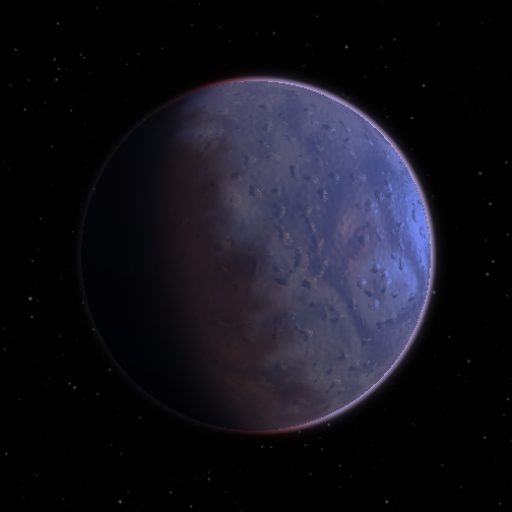
TRAPPIST-1 f
Also written TRAPPIST-1f, TRAPPIST 1f, TRAPPIST 1 f
- Mass
- 1.04 × Earth
- Radius
- 1.04 × Earth
- Gravity
- 0.96 g
- Surface (est.)
- 222 K
- Year
- 9.2 days
- From Earth
- 40.4 ly
- Mass
- 1.04 × Earth
- Radius
- 1.04 × Earth
- Gravity
- 0.96 g
- Surface (est.)
- 222 K
- Year
- 9.2 days
- From Earth
- 40.4 ly
TRAPPIST-1 system
- Type
- M-type (Red Dwarf)
- Spectral type
- M8.0 V
- Temperature
- 2,566 K
- Radius
- 0.119 ☉
- Mass
- 0.0898 ☉
- Planets
- 7
- Luminosity
- 5.53e-4 ☉
Published by the NASA Exoplanet Archive. This world’s temperature and habitability score are computed from this star’s measured luminosity, not from a stand-in for its class.
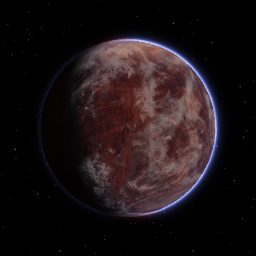
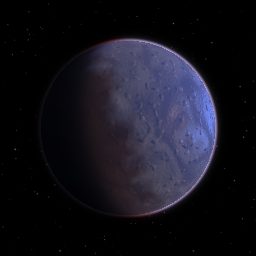 TRAPPIST-1 f0.038 AUYou are here1.0 M⊕
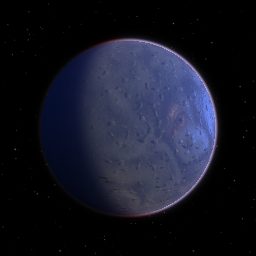
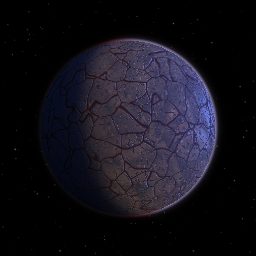
Star and planets drawn to scale: the star is 12 times as wide as TRAPPIST-1 f, so only its edge is in view. Orbits spaced as in the star system view.
In bulk, TRAPPIST-1 f is the member of its family that most resembles Earth: its mass and its width are both about 1.04 times Earth's. It lies in its star's habitable zone, the range of distances where liquid water could last on a surface given the right atmosphere. Yet it receives only about as much energy from its dim red star as Mars gets from the Sun, and it completes an orbit every 9.21 days.
Surface. Frozen surface covered in water ice, possible subsurface ocean if tidal heating present



Thin nitrogen and methane atmosphere
Nitrogen atmosphere provides protection but not breathable (partially stripped by slow rotation)Physical Properties
Elemental Composition
How TerraForge built this world
TRAPPIST-1 f, from the NASA Exoplanet Archive (found 2017). Measured: 1.04 Earth masses, 0.0385 AU, a 2566 K M-type star. Composition inferred from a measured bulk density of 0.92x Earth's at this size, suggesting roughly 5% water/ice by mass, with a day locked to its 9.2-day year, as anything orbiting this close would be.