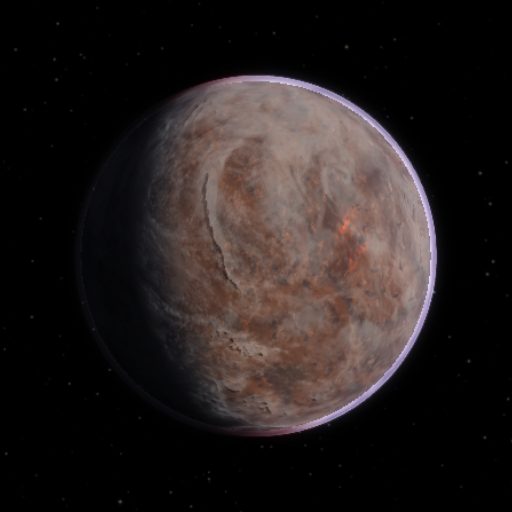
In bulk, TRAPPIST-1 f is the member of its family that most resembles Earth: its mass and its width are both about 1.04 times Earth's. It lies in its star's habitable zone, the range of distances where liquid water could last on a surface given the right atmosphere. Yet it receives only about as much energy from its dim red star as Mars gets from the Sun, and it completes an orbit every 9.21 days.
Planet f was announced in Nature in February 2017 by a team led by Michaël Gillon, from transits seen with NASA's Spitzer Space Telescope and telescopes on the ground. A transit is the small dip in starlight when a planet crosses in front of its star. The same study found the six inner planets moving in a near-resonant pattern: their periods of 1.51, 2.42, 4.04, 6.06, 9.21 and 12.35 days form nearly whole-number ratios. That suggests the planets formed farther out and migrated inward.
Those tightly linked orbits also let astronomers weigh the planets. Each planet tugs on its neighbours and slightly shifts when their transits happen. Using these timing shifts, a 2021 study led by Eric Agol measured all seven masses to within 3 to 5 percent. It found that one rocky recipe, lighter than Earth's, fits every planet. Either they hold less iron, about 21 percent by weight against Earth's 32, or they have Earth-like iron plus extra light material, such as water at the surface.
Webb's first transit spectra of f come from five transits observed with its NIRISS instrument, in a study led by Olivia Lim, accepted for publication in 2026. At least one stellar flare struck during every visit. Unlike spectra of planets closer in, f's showed no clear contamination from spots on the star, though the team cautions this may not hold in future visits. The cleanest visits rule out atmospheres dominated by hydrogen and helium thicker than about 20 millibars, roughly 2 percent of Earth's surface pressure. For heavier atmospheres, such as nitrogen or carbon dioxide, the limits depend on how the data are processed, so whether f has air remains open. Webb has found little to no atmosphere on b and c, the two innermost planets.
TerraForge's model, working only from f's mass, orbit and star, classifies it as an ice world at 222 K, near the archive's equilibrium temperature of 218 K, the temperature from starlight alone with no greenhouse warming. That is a fair reading of a Mars-like energy budget, and Agol's study leaves room for surface water. But f's density matches its rocky siblings, and without a detected atmosphere nobody can yet say whether its surface is ice, bare rock or ocean.