Create your free account

Enter your email and we'll send a 6-digit code — no password needed.
We only keep your email and the username you choose. We never share or sell your email, and we don't send marketing — we use it only to email you a sign-in code. Read our privacy policy.
Planet profiles

WASP-12 b

Gas Giant · 1,392 light-years away · Last reviewed October 14, 2026

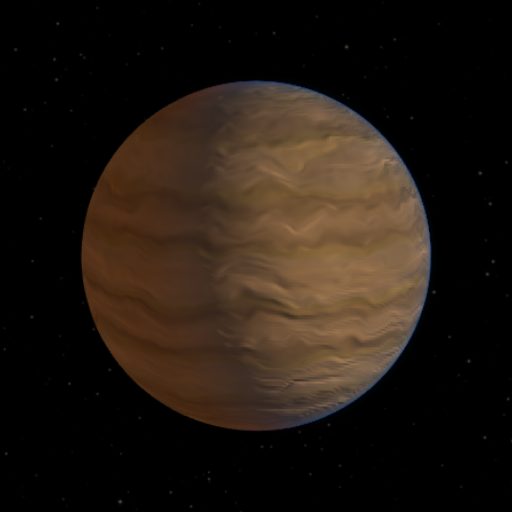
WASP-12 b rendered in TerraForge from its measured mass, orbit and star
TerraForge's rendering of WASP-12 b, generated by our physics engine from its measured mass, size, orbit and star. An illustration of what the science suggests, not a photograph.
TerraForge classification
Gas Giant
Host star
WASP-12
Distance
1,392 light-years
Orbit
1.09 days
Mass
467 × Earth
Radius
22 × Earth
Discovered
2008, transit

Figures from the NASA Exoplanet Archive. The classification is TerraForge’s, from its physics model.

This planet is spiralling slowly toward its star. Since its discovery, the time between its transits, when it passes in front of its star, has been shrinking by about 29 milliseconds a year. In 2019 a team led by Samuel Yee published new observations that ruled out other explanations. That made WASP-12 the first planetary system where astronomers could be confident an orbit is decaying. The cause is tides: the planet raises a bulge on its star, and friction inside the star slowly drains the planet's orbital energy. At the current rate, the orbit would shrink on a timescale of a few million years.

The SuperWASP team announced the planet in 2008 and titled their paper "the hottest transiting planet yet discovered". It had the largest radius of any transiting planet known then, about 1.8 times Jupiter's, and the shortest orbit, just 1.09 days. The archive lists its equilibrium temperature, the temperature from absorbing starlight alone, at about 2,600 kelvin. It lies roughly 1,400 light-years away.

Its closeness reshapes it. The star's gravity has stretched the planet into an egg shape. In 2010 Hubble spotted metals such as magnesium and sodium in a cloud of gas around the planet. That cloud spills beyond the region where the planet's own gravity holds on to its gas, suggesting material is being pulled away toward the star. In 2017 Hubble measured how much light the planet reflects. The answer was almost none: at most 6.4 percent, darker than fresh asphalt. Researchers think the heat breaks hydrogen molecules apart, leaving an atmosphere of atomic hydrogen and helium that absorbs rather than reflects light.

Some details remain open. The exact fate of the planet depends on how strongly the star absorbs tidal energy, which is inferred from the decay rate rather than measured directly. The 2010 team also saw an unexpected early dip in ultraviolet light and suggested, without confirming, that a disc of stripped gas might sit ahead of the planet.

TerraForge's model, using only mass, orbit and star, classifies it as a gas giant at about 2,560 kelvin with no habitability. Observations agree on the basics, but the model has no way to show the egg shape, the escaping gas or the shrinking orbit that define this world.

Sources

  1. WASP-12b: The hottest transiting planet yet discovered — arXiv (The Astrophysical Journal)
  2. The Orbit of WASP-12b is Decaying — arXiv (The Astrophysical Journal Letters)
  3. Metals in the Exosphere of the Highly Irradiated Planet WASP-12b — arXiv (The Astrophysical Journal Letters)
  4. Hubble observes pitch black planet — ESA/Hubble
A banded gas giant with four moons in different colors: a yellow sulfur moon, two rust-red rock moons and a blue water moon

New: Choose What Your Moons Are Made Of 🌙

Every moon used to be grey rock, white ice or blue ocean, decided for you. Now each one has a "Made of" choice in the builder's Moons tab — silicate rock, iron, water ice, carbon, sulfur, or nitrogen and methane ice — and the physics decides what that becomes. Put water ice too close to the star and it boils off to bare rock. Put sulfur where a neighbouring moon keeps it tidally flexed and it erupts in Io's yellows. Give a Titan-sized moon nitrogen ice far from the sun and it wraps itself in haze. Hang a water moon about the mass of Earth off a giant planet in the habitable zone and it can hold air and open seas — scored for life on the same scale as a planet, with a day as long as its orbit. A tint slider nudges the colour, but only as far as that material could really go.

Create your free account

Enter your email and we'll send a 6-digit code — no password needed.
We only keep your email and the username you choose. We never share or sell your email, and we don't send marketing — we use it only to email you a sign-in code. Read our privacy policy.

Send feedback

We're still building out the best experience we can — and we'd love your input. Tell us about features you enjoy, ideas you'd like to see, or pain points where something feels off, and we'll know where to look next.

Type
Idea
Bug
Pain point
Other