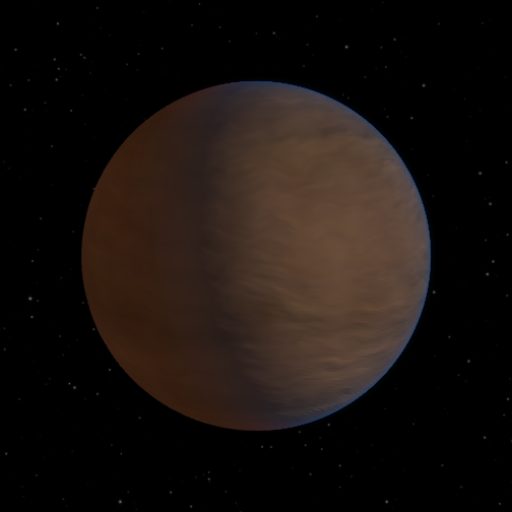
WASP-12 b
Also written WASP-12b, WASP 12b, WASP 12 b
- Mass
- 467.00 × Earth
- Radius
- 22.00 × Earth
- Gravity
- 0.96 g
- Surface (est.)
- 2,562 K
- Year
- 26.2 hrs
- From Earth
- 1,393 ly
- Mass
- 467.00 × Earth
- Radius
- 22.00 × Earth
- Gravity
- 0.96 g
- Surface (est.)
- 2,562 K
- Year
- 26.2 hrs
- From Earth
- 1,393 ly
WASP-12 system
- Type
- F-type (White)
- Temperature
- 6,265 K
- Radius
- 1.69 ☉
- Mass
- 1.32 ☉
- Planets
- 1
- Luminosity
- 3.95 ☉
Published by the NASA Exoplanet Archive. This world’s temperature and habitability score are computed from this star’s measured luminosity, not from a stand-in for its class.
 WASP-12 b0.023 AUYou are here467 M⊕
Star and planets drawn to scale: the star is 8.4 times as wide as WASP-12 b, so only its edge is in view. Orbits spaced as in the star system view.
This planet is spiralling slowly toward its star. Since its discovery, the time between its transits, when it passes in front of its star, has been shrinking by about 29 milliseconds a year. In 2019 a team led by Samuel Yee published new observations that ruled out other explanations. That made WASP-12 the first planetary system where astronomers could be confident an orbit is decaying. The cause is tides: the planet raises a bulge on its star, and friction inside the star slowly drains the planet's orbital energy. At the current rate, the orbit would shrink on a timescale of a few million years.
Surface. No solid surface - thick gaseous envelope with possible rocky core deep within


Hydrogen and helium dominated with trace methane and ammonia
Hydrogen-rich atmosphere typical of gas giantsPhysical Properties
Time Dilation
Clocks run 26.0 seconds per year slower than deep space — about 35 minutes over a lifetimeElemental Composition
How TerraForge built this world
WASP-12 b, from the NASA Exoplanet Archive (found 2008). Measured: 467 Earth masses, 0.0234 AU, a 6265 K F-type star. Composition inferred from a mass of 467 Earths, which is giant territory whatever its 0.04x density suggests, with a day locked to its 1.1-day year, as anything orbiting this close would be.