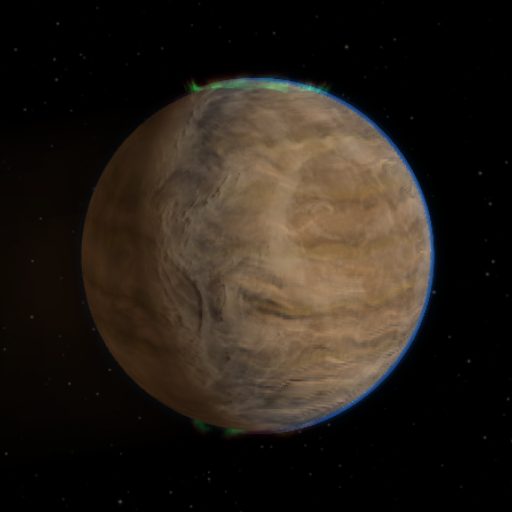
When the James Webb Space Telescope began science work, this hot, puffy planet was one of its first test cases, and it set several firsts. In 2022 Webb's Early Release Science team reported a clear signal of carbon dioxide in its atmosphere. Earlier telescopes had given hints of the gas on other planets, but never an unambiguous detection. Later that year Webb found sulfur dioxide there too. That gas is made when high-energy starlight drives chemical reactions in the air, a process called photochemistry. It was the first concrete evidence of photochemistry on an exoplanet.
The planet was announced in 2011 by the WASP survey, which watches for stars that dim slightly as a planet transits, or passes in front of, them. The discovery team called it a highly inflated Saturn-mass planet. It has about 0.28 times Jupiter's mass but a radius about 1.27 times Jupiter's, which made it one of the lowest-density planets then known. It orbits every 4.06 days, about 700 light-years away.
That low density is part of why it is so useful. A puffy atmosphere lets more starlight filter through its outer edge, so Webb can read the fingerprints of its gases. Besides carbon dioxide and sulfur dioxide, Webb found water, carbon monoxide, sodium and potassium. Its clouds appear broken up rather than a uniform blanket. In 2024 Webb's NIRSpec instrument measured the planet's morning and evening edges separately for the first time. The evening side came out roughly 200 degrees Celsius hotter, likely because fierce winds carry heat from the dayside around to the evening edge.
Some conclusions still rest on models. The atmosphere seems rich in heavy elements, which scientists take as a sign that the planet swallowed many solid building blocks as it grew. That is an inference about its past, not a direct observation. The morning side may also be cloudier than the evening, and researchers plan further work to see how clouds shape that temperature difference.
TerraForge's model, using only mass, orbit and star, classifies it as a gas giant at about 1,180 kelvin with no habitability. Observations agree, although at under a third of Jupiter's mass this world is closer to a hot, swollen Saturn than a Jupiter.