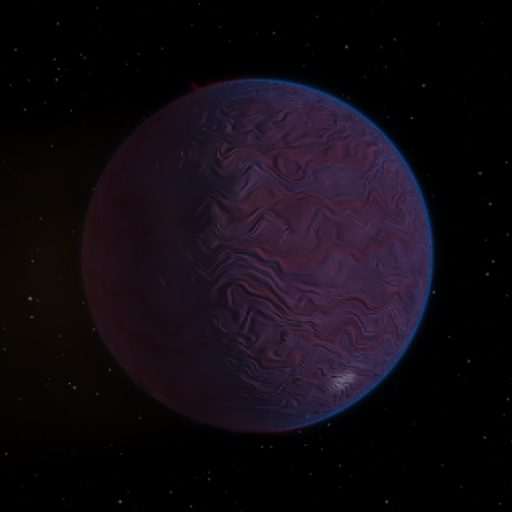
WASP-39 b
Also written WASP-39b, WASP 39b, WASP 39 b
- Mass
- 89.30 × Earth
- Radius
- 14.30 × Earth
- Gravity
- 0.44 g
- Surface (est.)
- 1,178 K
- Year
- 4.1 days
- From Earth
- 698 ly
- Mass
- 89.30 × Earth
- Radius
- 14.30 × Earth
- Gravity
- 0.44 g
- Surface (est.)
- 1,178 K
- Year
- 4.1 days
- From Earth
- 698 ly
WASP-39 system
- Type
- G-type (Yellow (Sun-like))
- Temperature
- 5,485 K
- Radius
- 0.939 ☉
- Mass
- 0.913 ☉
- Planets
- 1
- Luminosity
- 0.745 ☉
Published by the NASA Exoplanet Archive. This world’s temperature and habitability score are computed from this star’s measured luminosity, not from a stand-in for its class.
 WASP-39 b0.048 AUYou are here89 M⊕
Star and planets drawn to scale: the star is 7.2 times as wide as WASP-39 b, so only its edge is in view. Orbits spaced as in the star system view.
When the James Webb Space Telescope began science work, this hot, puffy planet was one of its first test cases, and it set several firsts. In 2022 Webb's Early Release Science team reported a clear signal of carbon dioxide in its atmosphere. Earlier telescopes had given hints of the gas on other planets, but never an unambiguous detection. Later that year Webb found sulfur dioxide there too. That gas is made when high-energy starlight drives chemical reactions in the air, a process called photochemistry. It was the first concrete evidence of photochemistry on an exoplanet.
Surface. No solid surface - thick gaseous envelope with possible rocky core deep within


Hydrogen and helium dominated with trace methane and ammonia
Hydrogen-rich atmosphere typical of gas giantsPhysical Properties
Time Dilation
Clocks run 9.7 seconds per year slower than deep space — about 13 minutes over a lifetimeElemental Composition
How TerraForge built this world
WASP-39 b, from the NASA Exoplanet Archive (found 2011). Measured: 89.3 Earth masses, 0.0483 AU, a 5485 K G-type star. Composition inferred from a mass of 89.3 Earths, which is giant territory whatever its 0.03x density suggests, with a day locked to its 4.1-day year, as anything orbiting this close would be.