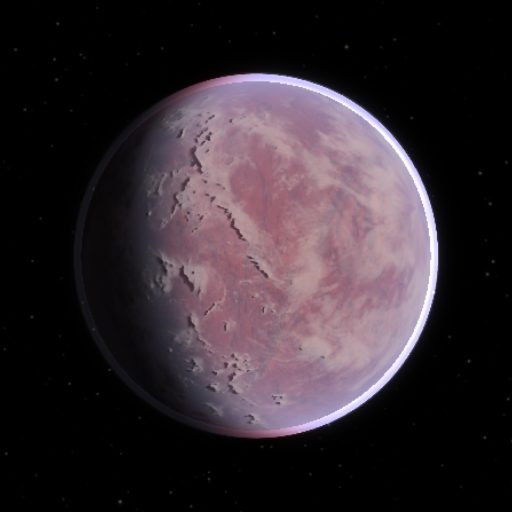
Wolf 1061 b is the innermost of three planets around Wolf 1061, a red dwarf about 14 light-years away. It orbits every 4.89 days. In 2016 a team led by D. J. Wright found it, together with its sibling Wolf 1061 c, by reanalysing archived data from the HARPS spectrograph in Chile with a custom method tailored to the star.
They used the radial velocity method, which detects the slight back-and-forth motion a planet's gravity gives its star. Wright's team reported a minimum mass of about 1.36 Earth masses for this planet, and a third planet on a 67-day orbit. A year later a HARPS team led by N. Astudillo-Defru analysed a larger set of measurements. They reached the same conclusions for the 4.9- and 17.9-day signals, so planets b and c were independently confirmed, but they did not find the 67-day signal significant. Instead they found a third planet on an orbit of about 217 days. Their estimate of b's minimum mass is about 1.9 Earth masses.
In 2017 a team led by Stephen Kane measured the star's size directly with the CHARA array of telescopes, used seven years of brightness measurements to find its rotation period of about 89 days, and confirmed that the planets' signals are not caused by the star's activity. They found no transits, so the planets' sizes are unknown. They placed the optimistic limits of the star's habitable zone, the range of distances where liquid water could last on a surface, at about 0.09 to 0.23 astronomical units. Wolf 1061 b, at about 0.04, is well inside that, too hot for liquid water. Its sibling Wolf 1061 c orbits within it.