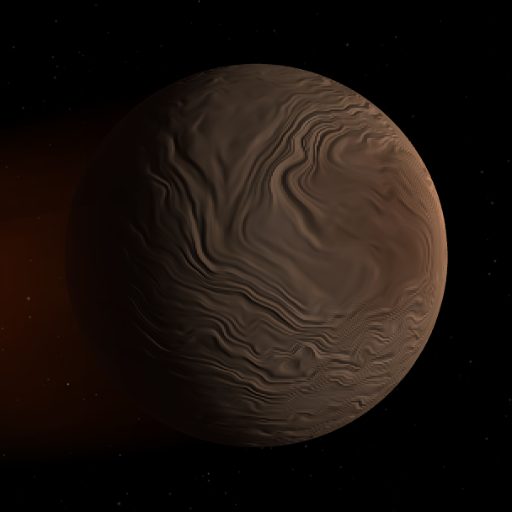
TOI-426 b
Also written TOI-426b, TOI 426b, TOI 426 b
- Mass
- 6.70 × Earth
- Radius
- 2.19 × Earth
- Gravity
- 1.40 g
- Surface (est.)
- 1,783 K
- Year
- 31.7 hrs
- From Earth
- 372 ly
- Mass
- 6.70 × Earth
- Radius
- 2.19 × Earth
- Gravity
- 1.40 g
- Surface (est.)
- 1,783 K
- Year
- 31.7 hrs
- From Earth
- 372 ly
TOI-426 system
- Type
- G-type (Yellow (Sun-like))
- Spectral type
- G2 V
- Temperature
- 5,750 K
- Radius
- 0.99 ☉
- Mass
- 1 ☉
- Planets
- 2
- Luminosity
- 0.951 ☉
Published by the NASA Exoplanet Archive. This world’s temperature and habitability score are computed from this star’s measured luminosity, not from a stand-in for its class.
 TOI-426 b0.024 AUYou are here6.7 M⊕
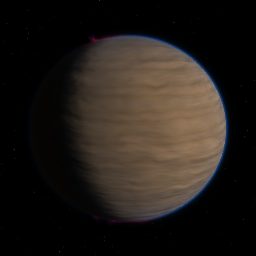
Star and planets drawn to scale: the star is 49 times as wide as TOI-426 b, so only its edge is in view. Orbits spaced as in the star system view.
Sub-Neptune, likely · its density could also fit a water world
TOI-426 b is an extremely irradiated sub-Neptune, between Earth and Neptune in size, that circles its Sun-like star every 1.32 days and receives about 1,700 times the light Earth gets from the Sun. The star, also known as HD 34390, is about 370 light-years away. The planet is about 2.2 times Earth's width and about 6.7 times its mass.
Surface. No solid surface - a hydrogen-helium envelope wrapped around a rocky core (a sub-Neptune)
Deep hydrogen-helium envelope with photochemical haze
Hydrogen-rich atmosphere typical of gas giants (its active star has stripped much of its air over 1.6 billion years)Physical Properties
Time Dilation
Clocks run 19.7 seconds per year slower than deep space — about 26 minutes over a lifetimeElemental Composition
How TerraForge built this world
TOI-426 b, from the NASA Exoplanet Archive (found 2026). Measured: 6.7 Earth masses, 0.0237 AU, a 5750 K G-type star. Composition inferred from a measured bulk density of 0.64x Earth's, too low for bare rock at this size, suggesting a rocky core under roughly a 2% hydrogen/helium envelope by mass, with a day locked to its 1.3-day year, as it is predicted to be tidally locked: at this distance its star would have stopped its spin within a million years.