Entering orbit…
AI assistant
Habitability
51/ 100
View planet
View star system
View surface
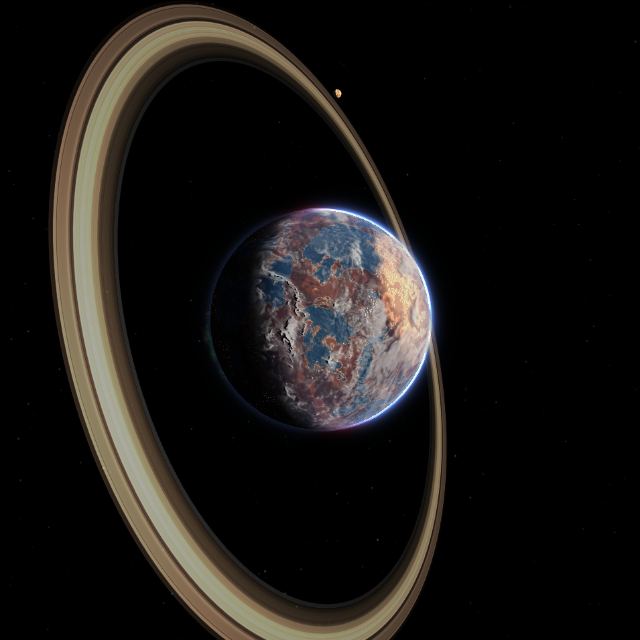
Ellomondo
- Mass
- 1.00 × Earth
- Radius
- 1.00 × Earth
- Gravity
- 1.00 g
- Surface
- 276 K
- Year
- 234 days
- Day
- 20.0 hrs
- Mass
- 1.00 × Earth
- Radius
- 1.00 × Earth
- Gravity
- 1.00 g
- Surface
- 276 K
- Year
- 234 days
- Day
- 20.0 hrs
Ellomondo's moons
2 moons
Moon 2Rock · 46,700 km
Moon 3Ice · 100,700 km
Planet, moons and orbits drawn to one scale; the smallest moons are enlarged so they can be seen.
Surface. Rocky surface with continents, oceans, and active plate tectonics. Diverse biomes if life present.
✓ Conditions could support life. This planet’s modelled conditions could support biological processes: stable temperatures, liquid water and the chemistry life as we know it needs. That makes life possible, not present.
Earth Like
✦ Ellomondo system
Your planet has a balanced composition with all CHNOPS elements, proper mass (1.0x Earth), and sits in the habitable zone at 0.66 AU.Life possibleMagnetic FieldModerate Activity
Earth-like planets have the perfect combination of composition, temperature, mass, and magnetic field to potentially support complex life as we know it.
Classification Criteria:
✓ All CHNOPS elements present (C, H, N, O, P, S)✓ Mass: 1.0x Earth (0.5-2.0x range)✓ Temperature: 276K (250-320K range)✓ Magnetic field present✓ Distance: 0.66 AU (habitable zone)
Habitability ScoreMarginal
Contributing Factors
water50
Limited water content
geology100
Active geology recycles nutrients and drives carbon cycle (tidal flexing sustains geologic activity)
rotation10
Near tidally locked - one hemisphere perpetually scorched, other frozen, narrow habitable twilight zone only
Organic Chemistry84
Core organic elements (CHNO) present (tidal pools cycle wet and dry - a boost for prebiotic chemistry)
atmosphere40
Nitrogen-oxygen atmosphere with trace CO₂, water vapor, and argon
Nitrogen-oxygen atmosphere - breathable and protective (partially stripped by slow rotation)temperature100
Optimal temperature range for liquid water and life (extreme seasons: at 70° the poles swing between months-long day and night: −14% habitability)
magnetic Field100
Magnetic field provides radiation protection
Physical Properties
Mass
1.00x Earth (5.97e+24 kg)Radius
1.00x Earth (6,371 km)Surface Gravity
1.00x Earth (9.8 m/s²)Surface Temperature
276 K (3 °C / 37 °F)Rotation Period
20.0 hours/day (faster than Earth)Elemental Composition
Closest Real Exoplanet
Teegarden's Star b91% similar
Orbiting Teegarden's Star| Yours | Teegarden's Star b | |
|---|---|---|
| Mass | 1.00 × Earth | 1.16 × Earth |
| Radius | 1.00 × Earth | 1.05 × Earth |
| Density (composition) | 5.50 g/cm³ | 5.52 g/cm³ |
| Temperature | 276.1 K | 277.0 K |
| Starlight received | 0.92 × Earth | 1.08 × Earth |
| Star temperature | 4,450 K | 3,034 K |
Moons
Moon 1rings
Inside the synchronous orbit: it spiraled inward and was torn apart at the Roche limit (Phobos's fate).
Moon 2receding
Outside the synchronous orbit: slowly receding, like Luna (~cm per year).
Tidal braking locked the planet to its moon: one face forever moonward.
Moon 3stable
Small and distant: a quiet, stable companion.
+10 geology: tidal flexing sustains geologic activity+4 chemistry: tidal pools cycle wet and dry - a boost for prebiotic chemistry