Entering orbit…
AI assistant
Habitability
81/ 100
View planet
View star system
View surface
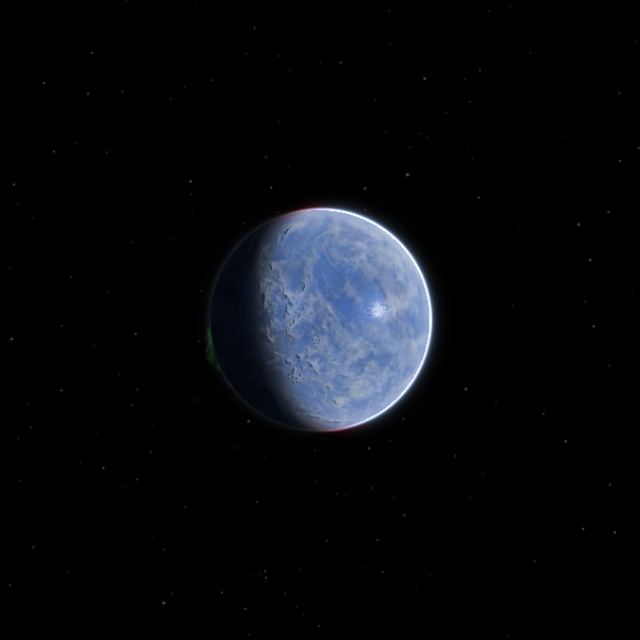
Situla II
0
The second planet and the only planet with liquid oceans, it is unknown if it harbours any sort of life underneath the boiling vast, never ending seas.
Water World
✦ Sitular SystemLife possibleMagnetic FieldModerate Activity
Why is this a Water World?
Your planet has abundant oxygen (27.3%) and hydrogen (36.4%), creating extensive water coverage while in the habitable temperature zone.Water worlds have deep global oceans covering most or all of their surface. They form when planets have high water content and orbit in the habitable zone.
Classification Criteria:
✓ Oxygen: 27.3% + Hydrogen: 36.4% (water-forming elements)✓ Temperature: 346K (habitable range)✓ Distance: 0.80 AU (habitable zone)
Habitability ScoreHighly Habitable
Contributing Factors
water100
Abundant water
geology90
Active geology recycles nutrients and drives carbon cycle
rotation60
Fast rotation - strong global wind patterns and weather systems, but manageable
Organic Chemistry80
Core organic elements (CHNO) present
atmosphere100
Nitrogen-oxygen atmosphere - breathable and protective
temperature70
Challenging but potentially habitable temperature (extreme seasons: at 67° the poles swing between months-long day and night, softened by deep oceans: −6% habitability)
magnetic Field100
Magnetic field provides radiation protection
Physical Properties
Mass
1.80x Earth (1.07e+25 kg)Radius
1.22x Earth (7,750 km)Surface Gravity
1.22x Earth (11.9 m/s²)Surface Temperature
346 K (73 °C / 164 °F)Rotation Period
15.0 hours/day (faster than Earth)Orbital Environment
Star Type
G-type (Yellow (Sun-like))Distance from Star
0.80 AU (120 million km)Orbital Period
261 daysAtmosphere
Nitrogen and oxygen with water vapor, mild greenhouse effect
Elemental Composition
H - Hydrogen
36.4%
O - Oxygen
27.3%
N - Nitrogen
11.4%
Surface Characteristics
Vast oceans covering most of the surface, scattered islands or archipelagosClosest Real Exoplanet
K2-3 d88% similar
Orbiting K2-3| Yours | K2-3 d | |
|---|---|---|
| Mass | 1.80 × Earth | 2.20 × Earth |
| Radius | 1.49 × Earth | 1.46 × Earth |
| Density (composition) | 3.00 g/cm³ | 3.90 g/cm³ |
| Temperature | 346.5 K | 305.0 K |
| Starlight received | 1.56 × Earth | 1.44 × Earth |
| Star temperature | 5,600 K | 3,844 K |
Moons
Moon 1stableSilicate rock0.0035% - 18.8 radii
Small and distant: a quiet, stable companion.
Moon 2recedingIron-rich rock0.16% - 61.1 radii
Outside the synchronous orbit: slowly receding, like Luna (~cm per year).
Habitability
✓ Conditions could support lifeThis planet’s modelled conditions could support biological processes: stable temperatures, liquid water and the chemistry life as we know it needs. That makes life possible, not present.Love TerraForge? Please help support us.Keeps it ad-free, and funds new features and hosting.