Entering orbit…
AI assistant
Habitability
9/ 100
View planet
View star system
View surface
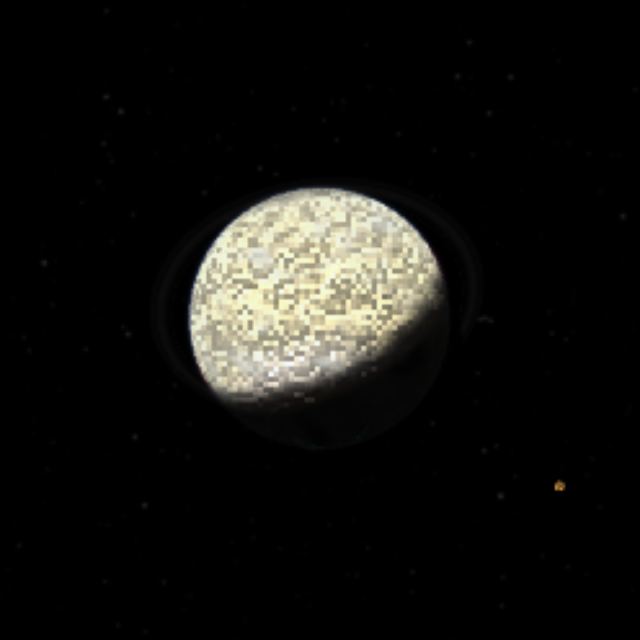
Uranium radiation (uranusium)
- Mass
- 1.00 × Earth
- Radius
- 1.00 × Earth
- Gravity
- 1.00 g
- Surface
- 288 K
- Year
- 365 days
- Day
- 24.0 hrs
- Mass
- 1.00 × Earth
- Radius
- 1.00 × Earth
- Gravity
- 1.00 g
- Surface
- 288 K
- Year
- 365 days
- Day
- 24.0 hrs
Uranium radiation (uranusium)'s star
G-type · Yellow (Sun-like)
Uranium radiation (uranusium)1.00 AUExotic TerrestrialYou are hereHabitable zone
Star and planet drawn to scale (a typical star of its class), with only the star's edge in view. Orbits spaced as in the star system view.
Uranium radiation (uranusium)'s moons
1 moon
Moon 2Sulfur · 86,000 km
Planet, moons and orbits drawn to one scale; the smallest moons are enlarged so they can be seen.
This world was used as a trash can for it's habitable destroyed neighbor's life, the trash dumped into this poor planet was mostly uranium
-fizzyteckee
Surface. Pale mineral plains — carbonate flats, chalk mesas, and crusts no silicate world can build
Exotic Terrestrial
Magnetic FieldHigh Activity
Exotic terrestrials are temperate solid worlds whose geology skipped the silicate playbook - carbonate plains, titanium-gray mesas, alkali flats. They can hold air, water ingredients, and real habitability, but with no silicate continents or iron core they are their own class, not earth-likes.
Classification Criteria:
✓ Exotic rock formers: 66.2% (>=12% Ca/Ti/Al/K/Ni/U)✓ Standard rock: 0.5% (<15% - silicate rules never claimed it)✓ Temperature: 288K (240-380K temperate band)✓ Air + water ingredients: 18.5% O+H (>=15%) with an atmosphere
Habitability ScoreUninhabitable
Contributing Factors
water62
Limited water content
geology90
Active geology recycles nutrients and drives carbon cycle
rotation100
Optimal rotation period - balanced day/night cycle, moderate weather, and good heat distribution
Organic Chemistry84
Core organic elements (CHNO) present (tidal pools cycle wet and dry - a boost for prebiotic chemistry) — but the ground itself is radioactive, and no magnetic field shields a world from its own crust
atmosphere50
Thin CO₂ atmosphere
CO₂ atmosphere with moderate greenhouse effecttemperature100
Optimal temperature range for liquid water and life
magnetic Field100
Magnetic field provides radiation protection
Physical Properties
Mass
1.00x Earth (5.97e+24 kg)Radius
1.00x Earth (6,371 km)Surface Gravity
1.00x Earth (9.8 m/s²)Surface Temperature
288 K (15 °C / 59 °F)Rotation Period
24.0 hours/dayElemental Composition
Closest Real Exoplanet
Teegarden's Star b87% similar
Orbiting Teegarden's Star| Yours | Teegarden's Star b | |
|---|---|---|
| Mass | 1.00 × Earth | 1.16 × Earth |
| Radius | 1.06 × Earth | 1.05 × Earth |
| Density (composition) | 4.60 g/cm³ | 5.52 g/cm³ |
| Temperature | 288.0 K | 277.0 K |
| Starlight received | 1.00 × Earth | 1.08 × Earth |
| Star temperature | 5,600 K | 3,034 K |
Moons
Moon 1rings
Inside the Roche limit (2.80 planet radii): torn apart into a ring system.
Moon 2stableSulfur-rich
Small and distant: a quiet, stable companion.
+4 chemistry: tidal pools cycle wet and dry - a boost for prebiotic chemistry