Entering orbit…
AI assistant
Habitability
48/ 100
View planet
View star system
View surface
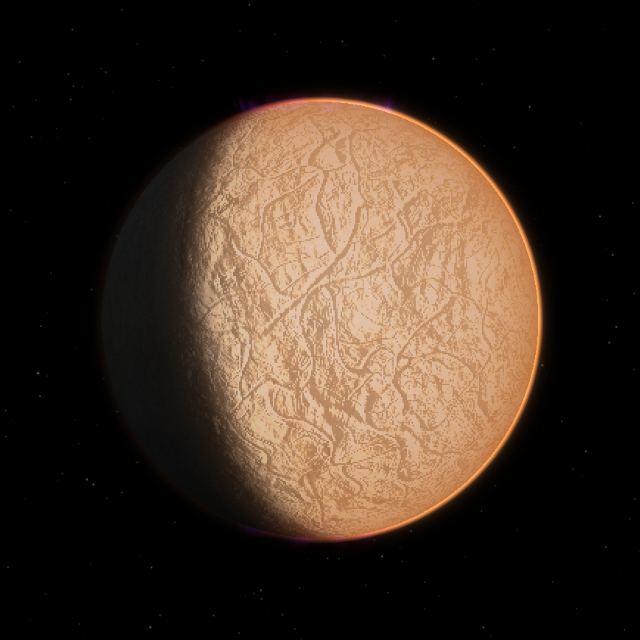
Hyrokkinn
0
Salt World
Magnetic FieldHigh Activity
Why is this a Salt World?Your planet is rich in sodium (4.7%) and chlorine (2.0%) but starved of hydrogen (3.9%), so instead of a water cycle it precipitates its salt into blinding evaporite flats.
Salt worlds need real halite chemistry - sodium and chlorine together, not just one - plus a dry recipe, since any real water cycle would dissolve the crust as fast as it forms. A warm 250-500K band keeps brines mobile enough to precipitate at the surface: halite plains, brine pans, salt-crusted ridges.
Classification Criteria:
✓ Sodium: 4.7% + Chlorine: 2.0% (min 3% each, 12% combined)✓ Hydrogen: 3.9% (<5% - dry enough for evaporites)✓ Temperature: 278K (250-500K warm band)✓ Silicon + Iron + Magnesium: 24.2% (>=15% - a rocky base to salt-crust over)
Habitability ScoreMarginal
Contributing Factors
water20
Very dry - minimal water
geology90
Active geology recycles nutrients and drives carbon cycle
rotation100
Optimal rotation period - balanced day/night cycle, moderate weather, and good heat distribution
Organic Chemistry100
All CHNOPS elements present - building blocks of life
atmosphere40
Atmosphere present but composition not ideal for life
temperature100
Optimal temperature range for liquid water and life
magnetic Field100
Magnetic field provides radiation protection
Physical Properties
Mass
1.00x Earth (5.97e+24 kg)Radius
1.00x Earth (6,371 km)Surface Gravity
1.00x Earth (9.8 m/s²)Surface Temperature
278 K (5 °C / 41 °F)Rotation Period
24.0 hours/dayOrbital Environment
Star Type
G-type (Yellow (Sun-like))Distance from Star
1.00 AU (150 million km)Orbital Period
1.00 yearsAtmosphere
Thin dry atmosphere with sodium dust and chlorine traces
Elemental Composition
Ar - Argon
27.0%
Fe - Iron
22.3%
N - Nitrogen
12.9%
Surface Characteristics
Blinding white evaporite flats - halite plains, brine pans, and salt-crusted ridgesClosest Real Exoplanet
Teegarden's Star b87% similar
Orbiting Teegarden's Star| Yours | Teegarden's Star b | |
|---|---|---|
| Mass | 1.00 × Earth | 1.16 × Earth |
| Radius | 1.02 × Earth | 1.05 × Earth |
| Density (composition) | 5.20 g/cm³ | 5.52 g/cm³ |
| Temperature | 278.0 K | 277.0 K |
| Starlight received | 1.00 × Earth | 1.08 × Earth |
| Star temperature | 5,600 K | 3,034 K |