Entering orbit…
AI assistant
Habitability
66/ 100
View planet
View star system
View surface
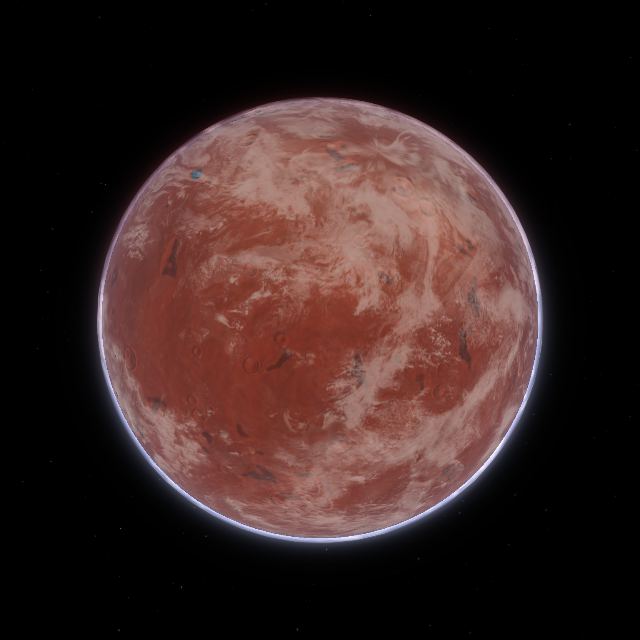
Ashak
0
Rocky Terrestrial
✦ YesutLife possibleLow Activity
Why is this a Rocky Terrestrial?
Your planet is dominated by silicate (13.5%) and iron (11.2%) content, forming a rocky terrestrial body.Rocky terrestrial planets are primarily composed of silicate rocks and metals. They're the most common type of small planet in the universe.
Classification Criteria:
✓ Silicon: 13.5% + Iron: 11.2% + Magnesium: 11.2%✓ Mass: 0.4x Earth (terrestrial range)
Habitability ScoreHabitable
Contributing Factors
water61
Good water content (low gravity lets water escape to space)
geology60
Some geological activity provides slow nutrient cycling
rotation100
Optimal rotation period - balanced day/night cycle, moderate weather, and good heat distribution
Organic Chemistry80
Core organic elements (CHNO) present
atmosphere70
Nitrogen atmosphere provides protection but not breathable
temperature70
Challenging but potentially habitable temperature
magnetic Field30
No magnetic field - vulnerable to solar radiation
Physical Properties
Mass
0.40x Earth (2.39e+24 kg)Radius
0.74x Earth (4,694 km)Surface Gravity
0.74x Earth (7.2 m/s²)Surface Temperature
324 K (51 °C / 123 °F)Rotation Period
25.0 hours/day (slower than Earth)Orbital Environment
Star Type
K-type (Orange)Distance from Star
0.78 AU (117 million km)Orbital Period
301 daysAtmosphere
Thin CO₂ and nitrogen atmosphere
Elemental Composition
O - Oxygen
19.1%
C - Carbon
14.6%
H - Hydrogen
14.6%
Surface Characteristics
Rocky surface with impact craters, possible volcanic featuresClosest Real Exoplanet
TRAPPIST-1 d84% similar
Orbiting TRAPPIST-1| Yours | TRAPPIST-1 d | |
|---|---|---|
| Mass | 0.40 × Earth | 0.39 × Earth |
| Radius | 0.79 × Earth | 0.79 × Earth |
| Density (composition) | 4.45 g/cm³ | 4.37 g/cm³ |
| Temperature | 323.9 K | 286.0 K |
| Starlight received | 0.66 × Earth | 1.11 × Earth |
| Star temperature | 4,450 K | 2,566 K |
Habitability
✓ Conditions could support lifeThis planet’s modelled conditions could support biological processes: stable temperatures, liquid water and the chemistry life as we know it needs. That makes life possible, not present.Love TerraForge? Please help support us.Keeps it ad-free, and funds new features and hosting.