Entering orbit…
AI assistant
Habitability
30/ 100
View planet
View star system
View surface
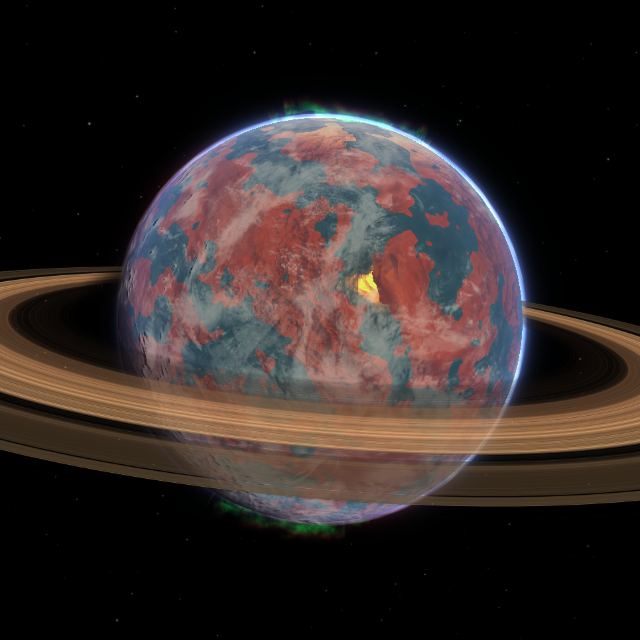
k-1a
0
Rocky Terrestrial
✦ k-1Magnetic FieldModerate Activity
Why is this a Rocky Terrestrial?Your planet is dominated by silicate (19.0%) and iron (14.3%) content, forming a rocky terrestrial body. Its hydrogen and oxygen stock collects as scattered seas across the rocky crust.
Rocky terrestrial planets are primarily composed of silicate rocks and metals. They're the most common type of small planet in the universe.
Classification Criteria:
✓ Silicon: 19.0% + Iron: 14.3% + Magnesium: 11.4%✓ Mass: 1.9x Earth (terrestrial range)
Habitability ScoreExtremely Harsh
Contributing Factors
water100
Abundant water
geology90
Active geology recycles nutrients and drives carbon cycle
rotation60
Fast rotation - strong global wind patterns and weather systems, but manageable
Organic Chemistry20
Limited organic chemistry potential
atmosphere70
Nitrogen atmosphere provides protection but not breathable
temperature100
Optimal temperature range for liquid water and life
magnetic Field100
Magnetic field provides radiation protection
Physical Properties
Mass
1.90x Earth (1.13e+25 kg)Radius
1.24x Earth (7,891 km)Surface Gravity
1.24x Earth (12.2 m/s²)Surface Temperature
285 K (12 °C / 54 °F)Rotation Period
12.0 hours/day (faster than Earth)Orbital Environment
Star Type
M-type (Red Dwarf)Distance from Star
0.19 AU (28.4 million km)Orbital Period
55 daysAtmosphere
Thin nitrogen atmosphere
Elemental Composition
H - Hydrogen
19.0%
Si - Silicon
19.0%
O - Oxygen
14.3%
Surface Characteristics
Rocky surface with impact craters, possible volcanic featuresClosest Real Exoplanet
K2-72 e94% similar
Orbiting K2-72| Yours | K2-72 e | |
|---|---|---|
| Mass | 1.90 × Earth | 2.21 × Earth |
| Radius | 1.20 × Earth | 1.29 × Earth |
| Density (composition) | 5.99 g/cm³ | 5.67 g/cm³ |
| Temperature | 285.2 K | 286.0 K |
| Starlight received | 1.11 × Earth | 1.20 × Earth |
| Star temperature | 3,050 K | 3,360 K |
Moons
Moon 1rings10% - 2.2 radii
Inside the Roche limit (2.80 planet radii): torn apart into a ring system.
Moon 2merged1.0% - 6.2 radii
Merged with an adjacent moon: too close for both to hold a stable orbit.