Entering orbit…
AI assistant
Habitabilityno longer habitable
View planet
View star system
View surface
Unknown
0
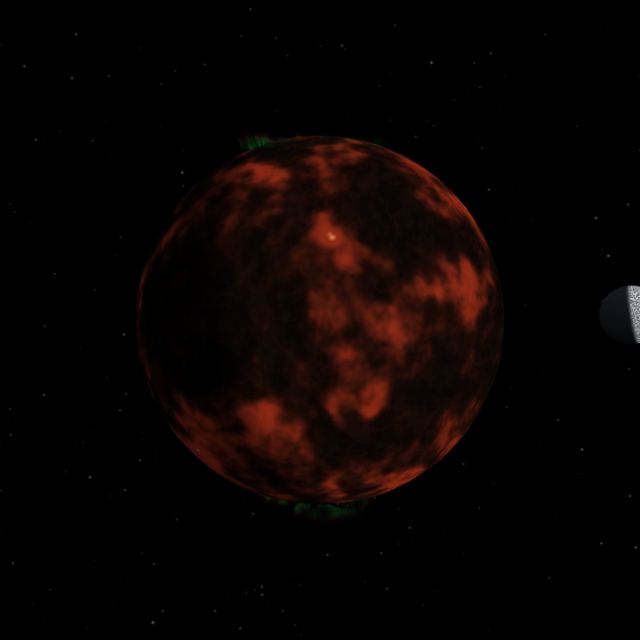
Volcanic World
✦ Solar System PlusDestroyed — no longer habitableMagnetic FieldExtreme Activity
Why is this a Volcanic World?
Runaway tidal heating from its moons drives volcanism across a cold crust - the planet is kneaded like Io.Resonant, close-in moons pump orbital eccentricity, and the resulting tidal flexing dissipates enormous heat in the interior. Only a fraction of the surface is molten at once, so the ground between the vents stays as cold as the orbit allows - Io's own equilibrium temperature is about 110 K.
Classification Criteria:
✓ Close-in moons in a resonant configuration✓ Tidal heat flux beyond the runaway threshold- The orbit is not what melted it: 2.15 AU, 192K equilibrium
Habitability
Destroyed — no longer habitablePhysical Properties
Mass
23.00x Earth (1.37e+26 kg)Radius
2.84x Earth (18,118 km)Surface Gravity
2.84x Earth (27.9 m/s²)Surface Temperature
192 K (-81 °C / -114 °F)Rotation Period
1.0 hours/day (faster than Earth)Orbital Environment
Star Type
G-type (Yellow (Sun-like))Distance from Star
2.15 AU (322 million km)Orbital Period
3.15 yearsAtmosphere
Volcanic outgassing - sulfur compounds and vaporized rock
Elemental Composition
O - Oxygen
25.8%
H - Hydrogen
16.3%
Fe - Iron
11.5%
Surface Characteristics
Runaway tidal heating drives volcanism across a cold crust - lava lakes and sulfur plains between frozen plainsClosest Real Exoplanet
TOI-561 f72% similar
Orbiting TOI-561| Yours | TOI-561 f | |
|---|---|---|
| Mass | 23.0 × Earth | 19.1 × Earth |
| Radius | 2.35 × Earth | 2.32 × Earth |
| Density (composition) | 9.80 g/cm³ | 8.43 g/cm³ |
| Temperature | 191.9 K | — |
| Starlight received | 0.22 × Earth | 0.47 × Earth |
| Star temperature | 5,600 K | 5,326 K |
Love TerraForge? Please help support us.Keeps it ad-free, and funds new features and hosting.