Entering orbit…
AI assistant
Habitability
13/ 100
View planet
View star system
View surface
Uni
- Mass
- 1.10 × Earth
- Radius
- 1.03 × Earth
- Gravity
- 1.03 g
- Surface
- 278 K
- Year
- 9.8 days
- Day
- 33.0 hrs
- Mass
- 1.10 × Earth
- Radius
- 1.03 × Earth
- Gravity
- 1.03 g
- Surface
- 278 K
- Year
- 9.8 days
- Day
- 33.0 hrs
Uni's star
Neutron Star
Uni0.10 AUExotic TerrestrialYou are hereHabitable zone
Star and planet drawn to scale (a typical star of its class), with only the star's edge in view. Orbits spaced as in the star system view.
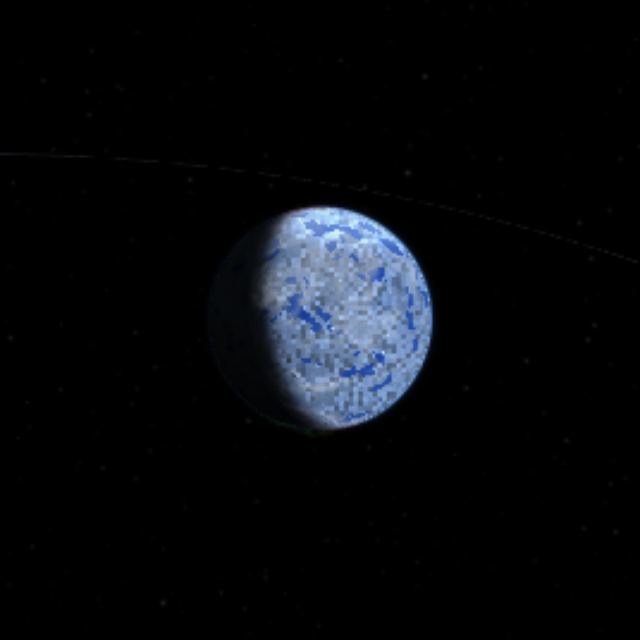
An exotic terrestrial planet orbiting a pulsar. Mostly good (maybe), but slight problems make it uninhabitable. Still life is possible.
Surface. Pale mineral plains — carbonate flats, chalk mesas, and crusts no silicate world can build
✓ Conditions could support life. This planet’s modelled conditions could support biological processes: stable temperatures, liquid water and the chemistry life as we know it needs. That makes life possible, not present.
Exotic Terrestrial
Life possibleMagnetic FieldHigh Activity
Exotic terrestrials are temperate solid worlds whose geology skipped the silicate playbook - carbonate plains, titanium-gray mesas, alkali flats. They can hold air, water ingredients, and real habitability, but with no silicate continents or iron core they are their own class, not earth-likes.
Classification Criteria:
✓ Exotic rock formers: 47.1% (>=12% Ca/Ti/Al/K/Ni/U)✓ Standard rock: 13.7% (<15% - silicate rules never claimed it)✓ Temperature: 278K (240-380K temperate band)✓ Air + water ingredients: 19.6% O+H (>=15%) with an atmosphere
Habitability ScoreUninhabitable
Contributing Factors
water88
Good water content
geology90
Active geology recycles nutrients and drives carbon cycle
rotation100
Optimal rotation period - balanced day/night cycle, moderate weather, and good heat distribution
Organic Chemistry20
Limited organic chemistry potential
atmosphere40
Thin trace-gas atmosphere
Atmosphere present but composition not ideal for lifetemperature100
Optimal temperature range for liquid water and life
magnetic Field100
Magnetic field provides radiation protection — but the pulsar's beams bathe this orbit in hard X-rays
Physical Properties
Mass
1.10x Earth (6.57e+24 kg)Radius
1.03x Earth (6,577 km)Surface Gravity
1.03x Earth (10.1 m/s²)Surface Temperature
278 K (5 °C / 41 °F)Rotation Period
33.0 hours/day (slower than Earth)Time Dilation
Clocks run 6.5 seconds per year slower than deep space — about 9 minutes over a lifetimeElemental Composition
Closest Real Exoplanet
Teegarden's Star b95% similar
Orbiting Teegarden's Star| Yours | Teegarden's Star b | |
|---|---|---|
| Mass | 1.10 × Earth | 1.16 × Earth |
| Radius | 1.09 × Earth | 1.05 × Earth |
| Density (composition) | 4.68 g/cm³ | 5.52 g/cm³ |
| Temperature | 278.0 K | 277.0 K |
| Starlight received | 1.00 × Earth | 1.08 × Earth |
| Star temperature | — | 3,034 K |
Moons
Moon 1rings
Inside the synchronous orbit: it spiraled inward and was torn apart at the Roche limit (Phobos's fate).