Entering orbit…
AI assistant
Habitability
62/ 100
View planet
View star system
View surface
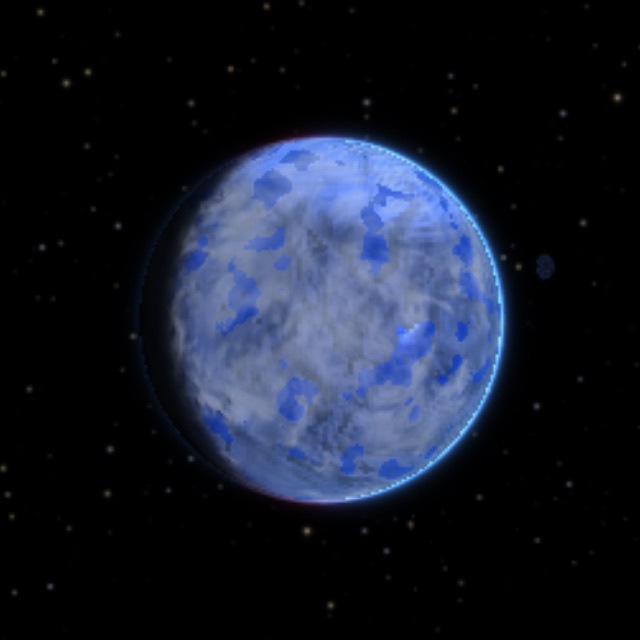
Vantaris
0
A world of rolling, silver, grassy hills and shallow, salty seas. The surface is dotted with impact craters and the poles are covered in ice.
Rocky Terrestrial
✦ Blue HaloLife possibleMagnetic FieldModerate Activity
Why is this a Rocky Terrestrial?
Your planet is dominated by silicate (37.7%) and iron (3.8%) content, forming a rocky terrestrial body.Rocky terrestrial planets are primarily composed of silicate rocks and metals. They're the most common type of small planet in the universe.
Classification Criteria:
✓ Silicon: 37.7% + Iron: 3.8% + Magnesium: 0.0%✓ Mass: 1.2x Earth (terrestrial range)
Habitability ScoreHabitable
Contributing Factors
water90
Good water content
geology90
Active geology recycles nutrients and drives carbon cycle
rotation10
Near tidally locked - one hemisphere perpetually scorched, other frozen, narrow habitable twilight zone only
Organic Chemistry80
Core organic elements (CHNO) present
atmosphere28
Nitrogen atmosphere provides protection but not breathable (partially stripped by slow rotation)
temperature100
Optimal temperature range for liquid water and life
magnetic Field100
Magnetic field provides radiation protection
Physical Properties
Mass
1.20x Earth (7.17e+24 kg)Radius
1.06x Earth (6,770 km)Surface Gravity
1.06x Earth (10.4 m/s²)Surface Temperature
292 K (19 °C / 67 °F)Rotation Period
22.0 hours/day (faster than Earth)Orbital Environment
Star Type
B-type (Blue Giant)Distance from Star
95.30 AU (14.3 billion km)Orbital Period
294.2 yearsAtmosphere
Thin CO₂ and nitrogen atmosphere
Elemental Composition
Si - Silicon
37.7%
O - Oxygen
20.8%
H - Hydrogen
11.3%
Surface Characteristics
Rocky surface with impact craters, possible volcanic featuresClosest Real Exoplanet
Kepler-1512 b71% similar
Orbiting Kepler-1512| Yours | Kepler-1512 b | |
|---|---|---|
| Mass | 1.20 × Earth | 1.76 × Earth |
| Radius | 1.06 × Earth | 1.18 × Earth |
| Density (composition) | 5.49 g/cm³ | 5.90 g/cm³ |
| Temperature | 292.5 K | 322.0 K |
| Starlight received | 1.10 × Earth | 1.60 × Earth |
| Star temperature | 20,000 K | 4,372 K |
Moons
Moon 1recedingVolcanic0.16% - 6.7 radii
Outside the synchronous orbit: slowly receding, like Luna (~cm per year).
Tidal braking locked the planet to its moon: one face forever moonward.
Tidal flexing melts its interior: an actively volcanic surface (Io-like).