Entering orbit…
AI assistant
Habitability
92/ 100
View planet
View star system
View surface
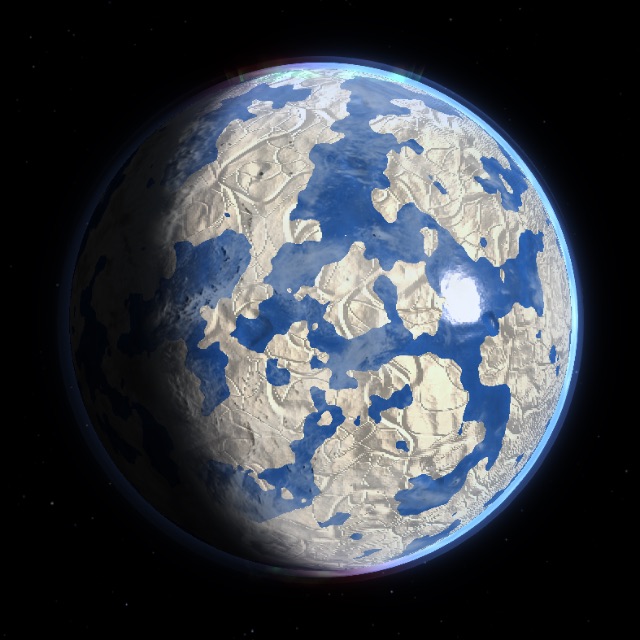
My willlys stuck help
Exotic Terrestrial
- Mass
- 1.00 × Earth
- Radius
- 1.00 × Earth
- Gravity
- 1.00 g
- Surface
- 286 K
- Year
- 344 days
- Day
- 24.0 hrs
- Mass
- 1.00 × Earth
- Radius
- 1.00 × Earth
- Gravity
- 1.00 g
- Surface
- 286 K
- Year
- 344 days
- Day
- 24.0 hrs
My willlys stuck help's star
G-type · Yellow (Sun-like)
My willlys stuck help0.96 AUExotic TerrestrialYou are hereHabitable zone
Star and planet drawn to scale (a typical star of its class), with only the star's edge in view. Orbits spaced as in the star system view.
It’s very very very very very very very very very very very very very very very very very very very very very very very very very very very very very very very very very nice
Surface. Pale mineral plains — carbonate flats, chalk mesas, and crusts no silicate world can build
✓ Conditions could support life. This planet’s modelled conditions could support biological processes: stable temperatures, liquid water and the chemistry life as we know it needs. That makes life possible, not present.
Exotic Terrestrial
Life possibleMagnetic FieldHigh Activity
Exotic terrestrials are temperate solid worlds whose geology skipped the silicate playbook - carbonate plains, titanium-gray mesas, alkali flats. They can hold air, water ingredients, and real habitability, but with no silicate continents or iron core they are their own class, not earth-likes.
Classification Criteria:
✓ Exotic rock formers: 25.7% (>=12% Ca/Ti/Al/K/Ni/U)✓ Standard rock: 9.3% (<15% - silicate rules never claimed it)✓ Temperature: 286K (240-380K temperate band)✓ Air + water ingredients: 37.2% O+H (>=15%) with an atmosphere
Habitability ScoreHighly Habitable
Contributing Factors
water100
Abundant water
geology90
Active geology recycles nutrients and drives carbon cycle
rotation100
Optimal rotation period - balanced day/night cycle, moderate weather, and good heat distribution
Organic Chemistry100
All CHNOPS elements present - building blocks of life
atmosphere70
Thin CO₂ and nitrogen atmosphere
Nitrogen atmosphere provides protection but not breathabletemperature100
Optimal temperature range for liquid water and life
magnetic Field100
Magnetic field provides radiation protection
Physical Properties
Mass
1.00x Earth (5.97e+24 kg)Radius
1.00x Earth (6,371 km)Surface Gravity
1.00x Earth (9.8 m/s²)Surface Temperature
286 K (13 °C / 56 °F)Rotation Period
24.0 hours/dayElemental Composition
Closest Real Exoplanet
Teegarden's Star b87% similar
Orbiting Teegarden's Star| Yours | Teegarden's Star b | |
|---|---|---|
| Mass | 1.00 × Earth | 1.16 × Earth |
| Radius | 1.06 × Earth | 1.05 × Earth |
| Density (composition) | 4.60 g/cm³ | 5.52 g/cm³ |
| Temperature | 286.4 K | 277.0 K |
| Starlight received | 1.09 × Earth | 1.08 × Earth |
| Star temperature | 5,600 K | 3,034 K |