Entering orbit…
AI assistant
Habitability
30/ 100
View planet
View star system
View surface
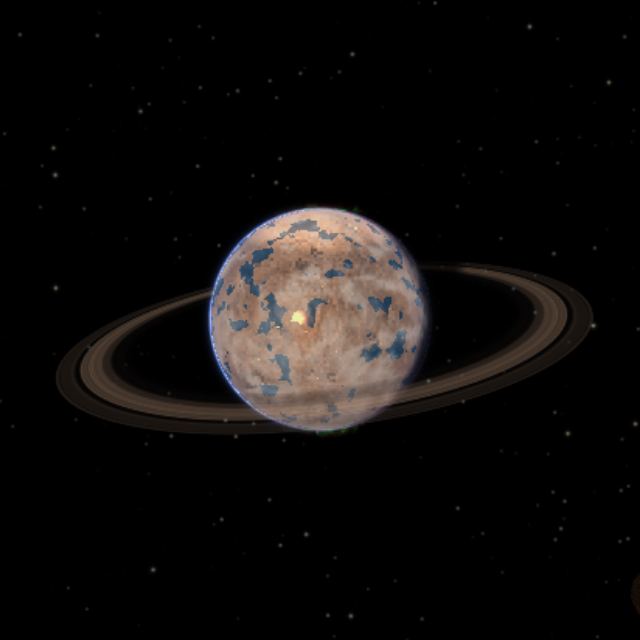
Exoto-893-B
0
a earth like plant that is hard to life on
it is the same size as earth
it orbits a k-type star and it has two moons
Exotic Terrestrial
Life possibleMagnetic FieldModerate Activity
Why is this a Exotic Terrestrial?
Your planet builds its crust from exotic minerals (28.0% calcium/titanium/aluminum-family rock formers) instead of the silicate-iron recipe every standard rocky world uses.Exotic terrestrials are temperate solid worlds whose geology skipped the silicate playbook - carbonate plains, titanium-gray mesas, alkali flats. They can hold air, water ingredients, and real habitability, but with no silicate continents or iron core they are their own class, not earth-likes.
Classification Criteria:
✓ Exotic rock formers: 28.0% (>=12% Ca/Ti/Al/K/Ni/U)✓ Standard rock: 8.1% (<15% - silicate rules never claimed it)✓ Temperature: 262K (240-380K temperate band)✓ Air + water ingredients: 56.5% O+H (>=15%) with an atmosphere
Habitability ScoreExtremely Harsh
Contributing Factors
water91
Abundant water - mostly frozen
geology90
Active geology recycles nutrients and drives carbon cycle
rotation10
Near tidally locked - one hemisphere perpetually scorched, other frozen, narrow habitable twilight zone only
Organic Chemistry20
Limited organic chemistry potential
atmosphere16
Atmosphere present but composition not ideal for life (partially stripped by slow rotation)
temperature70
Challenging but potentially habitable temperature
magnetic Field100
Magnetic field provides radiation protection
Physical Properties
Mass
1.00x Earth (5.97e+24 kg)Radius
1.00x Earth (6,371 km)Surface Gravity
1.00x Earth (9.8 m/s²)Surface Temperature
262 K (-11 °C / 13 °F)Rotation Period
24.0 hours/dayOrbital Environment
Star Type
K-type (Orange)Distance from Star
0.71 AU (106 million km)Orbital Period
261 daysAtmosphere
Thin oxygen atmosphere
Elemental Composition
H - Hydrogen
31.5%
Ti - Titanium
26.3%
O - Oxygen
25.0%
Surface Characteristics
Pale mineral plains — carbonate flats, chalk mesas, and crusts no silicate world can buildClosest Real Exoplanet
Kepler-1649 c90% similar
Orbiting Kepler-1649| Yours | Kepler-1649 c | |
|---|---|---|
| Mass | 1.00 × Earth | 1.20 × Earth |
| Radius | 1.06 × Earth | 1.06 × Earth |
| Density (composition) | 4.60 g/cm³ | 5.55 g/cm³ |
| Temperature | 262.5 K | 234.0 K |
| Starlight received | 0.79 × Earth | 0.75 × Earth |
| Star temperature | 4,450 K | 3,240 K |
Moons
Moon 1recedingVolcanic0.32% - 12.9 radii
Outside the synchronous orbit: slowly receding, like Luna (~cm per year).
Tidal braking locked the planet to its moon: one face forever moonward.
Tidal flexing melts its interior: an actively volcanic surface (Io-like).
Moon 2rings0.18% - 2.4 radii
Inside the Roche limit (2.80 planet radii): torn apart into a ring system.
Moon 3stableIron-rich rock0.00010% - 75.1 radii
Small and distant: a quiet, stable companion.
Habitability
✓ Conditions could support lifeThis planet’s modelled conditions could support biological processes: stable temperatures, liquid water and the chemistry life as we know it needs. That makes life possible, not present.Love TerraForge? Please help support us.Keeps it ad-free, and funds new features and hosting.