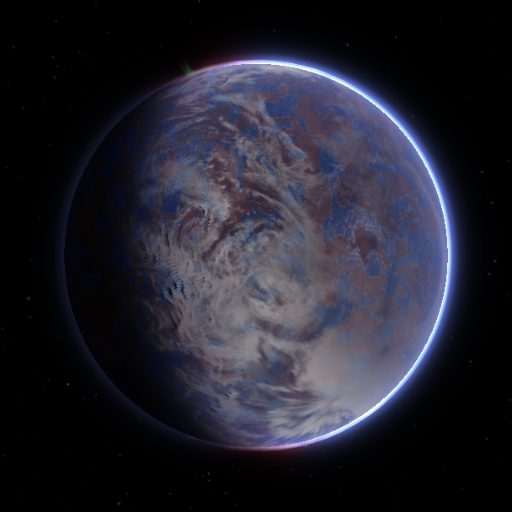
GJ 1061 c
Also written GJ 1061c
- Mass
- 1.81 × Earth
- Radius (est.)
- 1.19 × Earth
- Gravity (est.)
- 1.28 g
- Surface (est.)
- 310 K
- Year
- 6.7 days
- From Earth
- 12 ly
- Mass
- 1.81 × Earth
- Radius (est.)
- 1.19 × Earth
- Gravity (est.)
- 1.28 g
- Surface (est.)
- 310 K
- Year
- 6.7 days
- From Earth
- 12 ly
GJ 1061 system
- Type
- M-type (Red Dwarf)
- Spectral type
- M5.5 V
- Temperature
- 2,953 K
- Radius
- 0.156 ☉
- Mass
- 0.12 ☉
- Planets
- 3
- Luminosity
- 1.70e-3 ☉
Published by the NASA Exoplanet Archive. This world’s temperature and habitability score are computed from this star’s measured luminosity, not from a stand-in for its class.
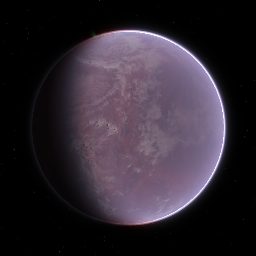
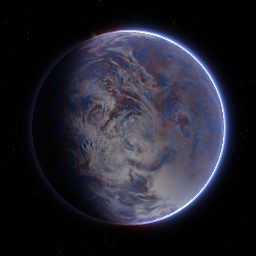
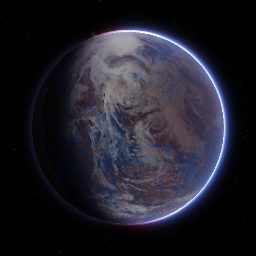
Star and planets drawn to scale: the star is 14 times as wide as GJ 1061 c, so only its edge is in view. Orbits spaced as in the star system view.
Estimated: this planet doesn't transit its star, so its size is inferred, not measured
GJ 1061 c is the heaviest of the three planets around GJ 1061, a small red dwarf about 12 light-years away and one of the 20 nearest stars to the Sun. It circles its star every 6.68 days and has a mass of about 1.76 Earth masses. It was discovered together with GJ 1061 b and d, announced by the Red Dots team led by Stefan Dreizler in 2019 and published in 2020.
Surface. Rocky surface with continents, oceans, and active plate tectonics. Diverse biomes if life present.
✓ Conditions could support life. This planet’s modelled conditions could support biological processes: stable temperatures, liquid water and the chemistry life as we know it needs. That makes life possible, not present.
Nitrogen-oxygen atmosphere with trace CO₂, water vapor, and argon
Nitrogen-oxygen atmosphere - breathable and protective (its active star has stripped much of its air over 7 billion years)Physical Properties
Elemental Composition
How TerraForge built this world
GJ 1061 c, from the NASA Exoplanet Archive (found 2020). Measured: 1.81 Earth masses, 0.0342 AU, a 2953 K M-type star. Composition inferred from an estimated bulk density of 1.07x Earth's, modeled rather than measured since this isn't a transiting planet — the radius is the archive's estimate, so it can't settle how much water there is; read as rock and iron, with a day locked to its 6.7-day year, as it is predicted to be tidally locked: at this distance its star would have stopped its spin within a million years.