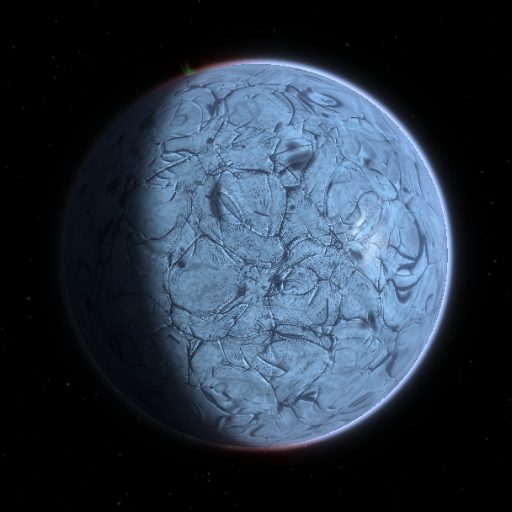
tau Cet f
Also written tau Cetf
- Mass
- 3.93 × Earth
- Radius (est.)
- 1.81 × Earth
- Gravity (est.)
- 1.20 g
- Surface (est.)
- 205 K
- Year
- 636 days
- From Earth
- 11.7 ly
- Mass
- 3.93 × Earth
- Radius (est.)
- 1.81 × Earth
- Gravity (est.)
- 1.20 g
- Surface (est.)
- 205 K
- Year
- 636 days
- From Earth
- 11.7 ly
tau Cet system
- Type
- G-type (Yellow (Sun-like))
- Spectral type
- G8.5V
- Temperature
- 5,310 K
- Radius
- 0.83 ☉
- Mass
- 0.783 ☉
- Planets
- 3
- Luminosity
- 0.495 ☉
Published by the NASA Exoplanet Archive. This world’s temperature and habitability score are computed from this star’s measured luminosity, not from a stand-in for its class.
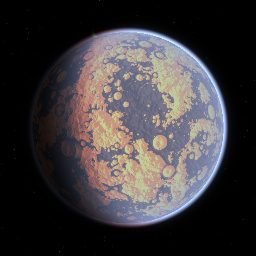
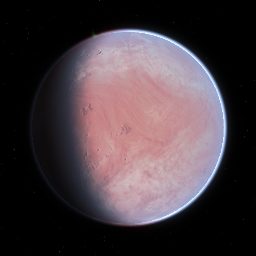
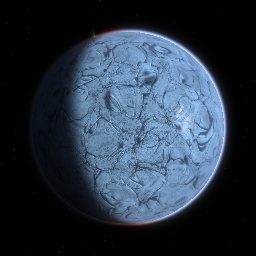
Star and planets drawn to scale: the star is 50 times as wide as tau Cet f, so only its edge is in view. Orbits spaced as in the star system view.
Estimated: this planet doesn't transit its star, so its size is inferred, not measured
Tau Ceti f orbits near the outer edge of the habitable zone of Tau Ceti, the closest single Sun-like star to us, about 12 light-years away. The habitable zone is the range of distances where a planet could keep liquid water on its surface. Tau Ceti f takes about 640 days to go around its star, and its minimum mass is about four times Earth's.
Surface. Frozen surface covered in water ice, possible subsurface ocean if tidal heating present


Thin nitrogen and methane atmosphere
Nitrogen atmosphere provides protection but not breathablePhysical Properties
Elemental Composition
How TerraForge built this world
tau Cet f, from the NASA Exoplanet Archive (found 2017). Measured: 3.93 Earth masses, 1.33 AU, a 5310 K G-type star. Composition inferred from an estimated bulk density of 0.66x Earth's, modeled rather than measured since this isn't a transiting planet — an envelope can't be inferred from estimated figures, so it is read as rock and iron, with an assumed 24-hour day — rotation cannot be measured for exoplanets.