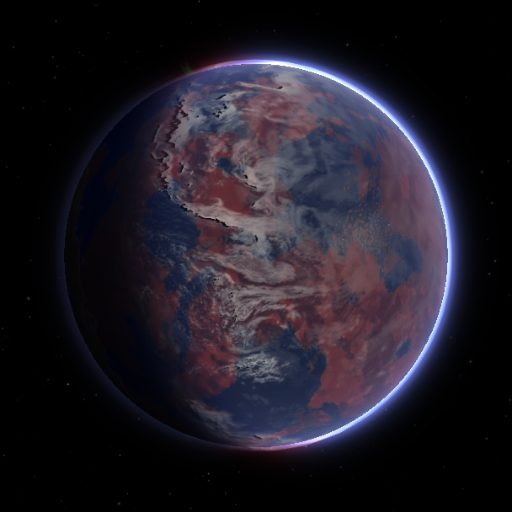
TRAPPIST-1 e
Also written TRAPPIST-1e, TRAPPIST 1e, TRAPPIST 1 e
- Mass
- 0.69 × Earth
- Radius
- 0.92 × Earth
- Gravity
- 0.82 g
- Surface (est.)
- 282 K
- Year
- 6.1 days
- From Earth
- 40.4 ly
- Mass
- 0.69 × Earth
- Radius
- 0.92 × Earth
- Gravity
- 0.82 g
- Surface (est.)
- 282 K
- Year
- 6.1 days
- From Earth
- 40.4 ly
TRAPPIST-1 system
- Type
- M-type (Red Dwarf)
- Spectral type
- M8.0 V
- Temperature
- 2,566 K
- Radius
- 0.119 ☉
- Mass
- 0.0898 ☉
- Planets
- 7
- Luminosity
- 5.53e-4 ☉
Published by the NASA Exoplanet Archive. This world’s temperature and habitability score are computed from this star’s measured luminosity, not from a stand-in for its class.
 TRAPPIST-1 e0.029 AUYou are here0.7 M⊕
Star and planets drawn to scale: the star is 14 times as wide as TRAPPIST-1 e, so only its edge is in view. Orbits spaced as in the star system view.
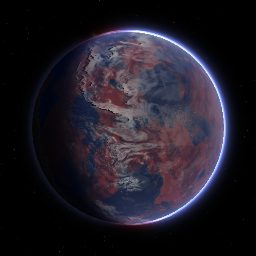
TRAPPIST-1 e is one of very few rocky planets that both sits in its star's habitable zone and can be studied in detail by the James Webb Space Telescope. The habitable zone is the range of distances where, with the right atmosphere, liquid water could last on a planet's surface. Planet e is close to Earth in size, about 0.92 times its width and 0.69 times its mass, and it circles its small red star every 6.1 days.
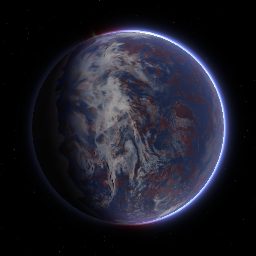
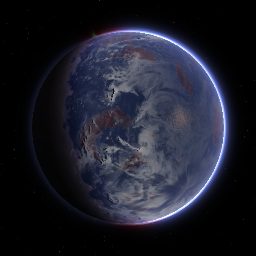
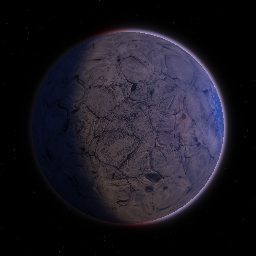
Surface. Rocky surface with continents, oceans, and active plate tectonics. Diverse biomes if life present.
✓ Conditions could support life. This planet’s modelled conditions could support biological processes: stable temperatures, liquid water and the chemistry life as we know it needs. That makes life possible, not present.
Nitrogen-oxygen atmosphere with trace CO₂, water vapor, and argon
Nitrogen-oxygen atmosphere - breathable and protective (its active star has stripped much of its air over 7.6 billion years)Physical Properties
Elemental Composition
How TerraForge built this world
TRAPPIST-1 e, from the NASA Exoplanet Archive (found 2017). Measured: 0.692 Earth masses, 0.0293 AU, a 2566 K M-type star. Composition inferred from a measured bulk density of 0.89x Earth's, which is rock and iron, with a day locked to its 6.1-day year, as it is predicted to be tidally locked: at this distance its star would have stopped its spin within a million years.