Create your free account

Enter your email and we'll send a 6-digit code — no password needed.
or use an email code
We only keep your email and the username you choose. We never share or sell your email, and we don't send marketing — we use it only to email you a sign-in code. Read our privacy policy.
Entering orbit…
Habitability
12/ 100
Uninhabitable
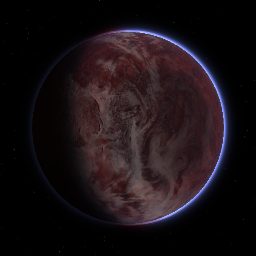
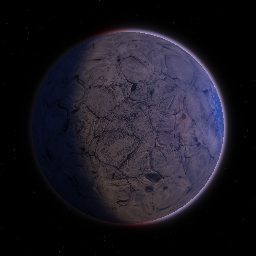
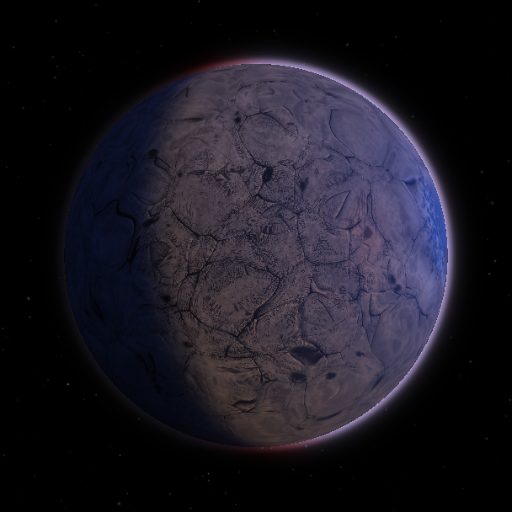
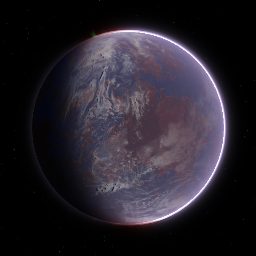
TRAPPIST-1 h rendered in TerraForge from its measured mass, orbit and star

TRAPPIST-1 h

Also written TRAPPIST-1h, TRAPPIST 1h, TRAPPIST 1 h

Ice World40 light years awayFound 2017
Mass
0.33 × Earth
Radius
0.76 × Earth
Gravity
0.57 g
Surface (est.)
174 K
Year
18.8 days
From Earth
40.4 ly
Mass
0.33 × Earth
Radius
0.76 × Earth
Gravity
0.57 g
Surface (est.)
174 K
Year
18.8 days
From Earth
40.4 ly

TRAPPIST-1 system

Type
M-type (Red Dwarf)
Spectral type
M8.0 V
Temperature
2,566 K
Radius
0.119 ☉
Mass
0.0898 ☉
Planets
7
Luminosity
5.53e-4 ☉

Published by the NASA Exoplanet Archive. This world’s temperature and habitability score are computed from this star’s measured luminosity, not from a stand-in for its class.
Habitable zone

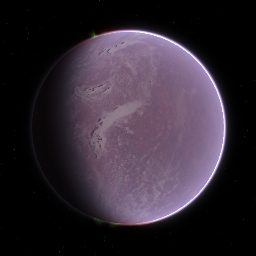
Star and planets drawn to scale: the star is 17 times as wide as TRAPPIST-1 h, so only its edge is in view. Orbits spaced as in the star system view.

TRAPPIST-1 h is the outermost and smallest of the seven planets around TRAPPIST-1, a small, cool red dwarf about 40 light-years away. It is about three-quarters of Earth's width and about a third of its mass. Its orbit, every 18.77 days, was the last piece of the system's puzzle.

Surface. Frozen surface covered in water ice, possible subsurface ocean if tidal heating present
Ice World
Life unlikely — too cold for liquid waterLow Activity
TRAPPIST-1 h orbits at 0.06 AU from its star, resulting in frigid temperatures of 174K.
Ice worlds form beyond the frost line where temperatures are low enough for water and other volatiles to freeze solid. They may have subsurface oceans beneath thick ice shells.
Classification Criteria:
✓ Distance: 0.06 AU (>3 AU) or Temperature <200K✓ Temperature: 174K✓ Water content: 35.7% for ice formation

Reading TRAPPIST-1 h’s atmosphere

Dominant elements: O, Si, Fe, N, H, CThis is what a telescope would measure while TRAPPIST-1 h crosses in front of its star: starlight passes through the atmosphere and spreads into a rainbow band. Each dark line marks a wavelength the atmosphere absorbed.Every element absorbs its own signature wavelengths — hydrogen always darkens the same two spots, calcium another pair, and so on. Astronomers match the lines in a real spectrum against a library of these signatures to say what an atmosphere is made of, light-years away, without ever visiting. A deeper line generally means more of that element is present.TRAPPIST-1 h sits about 40 light-years away, found by the transit method. Most catalogued distances trace back to parallax: as Earth orbits the Sun, a nearby star appears to shift very slightly against the distant background stars, and the size of that shift gives its distance directly.
Habitability ScoreUninhabitable
12
Contributing Factors
temperature17
Very cold - water frozen, challenging for life
atmosphere53

Thin nitrogen and methane atmosphere

Nitrogen atmosphere provides protection but not breathable (its active star has stripped much of its air over 7.6 billion years)
water13
Limited water content - frozen solid, no liquid phase at this temperature
magnetic Field30
No magnetic field - vulnerable to solar radiation
geology60
Some geological activity provides slow nutrient cycling
Organic Chemistry80
Core organic elements (CHNO) present
rotation47
Very slow rotation - days and nights each last several Earth days, bringing severe temperature swings

Physical Properties

Mass
0.33x Earth (1.95e+24 kg)
Radius
0.76x Earth (4,810 km)
This planet: 0.76× Earth radiusEarth: 1× (baseline)
Surface Gravity
0.57x Earth (5.6 m/s²)
Surface Temperature
174 K (-99 °C / -147 °F)
Rotation Period
451.2 hours/day (slower than Earth)
This planet: 451 h/dayEarth: 24 h/day

Elemental Composition

How TerraForge built this world

TRAPPIST-1 h, from the NASA Exoplanet Archive (found 2017). Measured: 0.326 Earth masses, 0.0619 AU, a 2566 K M-type star. Composition inferred from a measured bulk density of 0.76x Earth's at this size, suggesting roughly 5% water/ice by mass, with a day locked to its 18.8-day year, as it is predicted to be tidally locked: at this distance its star would have stopped its spin within a million years.

New: Fly Over Your World

The surface view used to be a place to stand. Now it's a place to go. Open any rocky world's surface and fly: the arrow keys take you across the ground on a computer, and on a phone or tablet you go full screen and tap Fly. Skim the dunes, climb over a ridge to see what's behind it, drop into a valley. It all comes from the same numbers that shape the globe, so no two worlds fly the same, and the real exoplanets are in there too.

Create your free account

Enter your email and we'll send a 6-digit code — no password needed.
or use an email code
We only keep your email and the username you choose. We never share or sell your email, and we don't send marketing — we use it only to email you a sign-in code. Read our privacy policy.

One quick check

You must be 13 or older to create an account. What year were you born?
2026
2025
2024
2023
2022
2021
2020
2019
2018
2017
2016
2015
2014
2013
2012
2011
2010
2009
2008
2007
2006
2005
2004
2003
2002
2001
2000
1999
1998
1997
1996
1995
1994
1993
1992
1991
1990
1989
1988
1987
1986
1985
1984
1983
1982
1981
1980
1979
1978
1977
1976
1975
1974
1973
1972
1971
1970
1969
1968
1967
1966
1965
1964
1963
1962
1961
1960
1959
1958
1957
1956
1955
1954
1953
1952
1951
1950
1949
1948
1947
1946
1945
1944
1943
1942
1941
1940

Sign-in

Send feedback

We're still building out the best experience we can — and we'd love your input. Tell us about features you enjoy, ideas you'd like to see, or pain points where something feels off, and we'll know where to look next.

Type
Idea
Bug
Pain point
Other